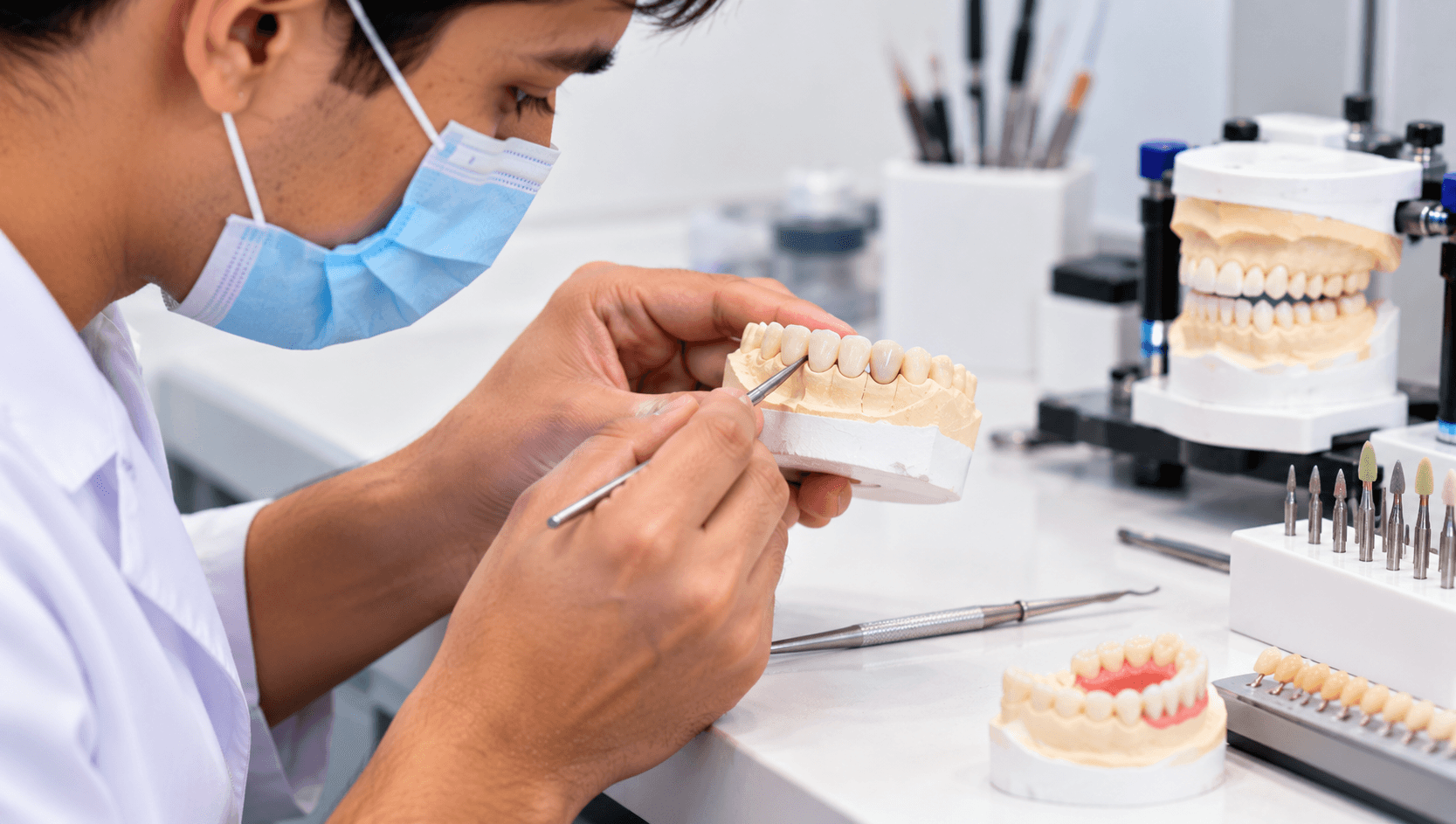
Every crown, denture, bridge and appliance a dentist delivers is made by someone, and in most cases that someone is a dental laboratory technician the patient never meets.
It is a skilled trade with a genuine craft element, a clear path from novice to expert, and - unusually among dental careers - a route that does not require a clinical degree. It is also a trade in the middle of the most significant technological change in its history, which creates both risk and opportunity for people entering now.
This guide covers what the work involves, how you qualify, how digital workflows are changing it, and what the career looks like.
What the work involves
Dental technology divides into areas, and most technicians specialise after a general grounding.
Removable prosthodontics: complete dentures and removable partial dentures, including cast cobalt-chromium frameworks, tooth setting, waxing, processing and finishing. Denture tooth setting to a clinician's jaw relation records is a skill that takes years to do well.
Fixed prosthodontics: crowns and bridges - waxing, casting, metal-ceramic work, and increasingly milled and pressed restorations.
Ceramics. The most aesthetically demanding specialism. Layering porcelain to reproduce the optical behaviour of natural enamel and dentine, with characterisation and staining. A skilled ceramist is the most sought-after and best-paid technician in most laboratories.
Orthodontic appliances: removable appliances, retainers, expanders, functional appliances and increasingly aligner production.
Implant prosthodontics: custom abutments, screw-retained and cement-retained superstructures, bars and full-arch frameworks. This is the fastest-growing area and the one where digital skills matter most.
Maxillofacial prosthetics: obturators, ocular and facial prostheses. A small, highly specialised and extremely rewarding field. Our Maxillofacial Prosthesis Course covers it specifically.
Qualifying
Routes differ by country, and in all of them the qualification matters less than the portfolio after the first few years - but the qualification is how you get those years.
In India, the recognised routes are a diploma in dental mechanics or dental technology, typically of around two years, and bachelor's degree programmes in dental technology offered by some institutions. Registration requirements vary by state.
In the United Kingdom, dental technicians register with the General Dental Council, with qualification through a recognised diploma or degree. Clinical dental technicians hold an additional qualification allowing them to provide complete dentures directly to patients - a significant extension of scope worth knowing about early.
In the United States, formal programmes accredited by the Commission on Dental Accreditation exist alongside on-the-job training, with the Certified Dental Technician credential available through examination in specific specialisms.
In Australia and New Zealand, vocational and degree-level qualifications lead to registration, with dental prosthetists holding an extended scope for removable prosthodontics directly with patients.
Across all of these, apprenticeship in a working laboratory alongside or after formal study is how competence actually develops. Theory tells you what a finish line is; three thousand margins tell you how to read one.
Our Online Dental Lab Technician Course covers dental technology and prosthesis fabrication remotely, and pairs naturally with laboratory experience.
The skills that matter
Manual dexterity and fine motor control, obviously. Less obviously, these improve substantially with deliberate practice - people who assume it is innate talent give up too early.
Colour perception and aesthetic judgement, particularly for ceramics. Worth testing yourself for colour vision deficiency early, because it affects which specialism suits you.
Spatial reasoning. You are reconstructing three-dimensional anatomy from a cast and a prescription.
Knowledge of dental anatomy, occlusion and materials science. Technicians who understand occlusion produce restorations that need less chairside adjustment, and clinicians notice.
Communication with clinicians. The best technicians ask questions about an inadequate prescription rather than guessing, and the relationships they build on that are what sustain a career.
Increasingly, digital skills: CAD software, scanner operation, milling and printing workflows, and basic file management.
How digital is changing the trade
This is the honest part of the picture and it should inform how you train.
CAD/CAM design and milling have substantially replaced the wax-and-cast workflow for crowns, bridges and frameworks. Intraoral scans arrive as files; models are printed rather than poured; frameworks are milled rather than cast.
3D printing has taken over models, surgical guides, trays, splints and provisionals, and is moving into definitive restorations as materials develop.
Some manual skills are consequently in less demand than they were. Hand waxing of single units is a diminishing requirement.
But three things have not been automated, and are unlikely to be soon. Ceramic layering and characterisation for high-aesthetic anterior work, where the judgement is perceptual rather than computational. Complete denture work, particularly tooth setting and the handling of difficult cases. And finishing - the final adjustment, texture and polish that distinguishes an acceptable restoration from an excellent one.
The practical conclusion for someone entering the field: learn the digital workflow as a baseline, because it is now the default, and develop depth in one of the areas that resists automation. A technician who can design in CAD and layer ceramic beautifully is in a far stronger position than one who can do either alone.
Career and earnings
Progression typically runs from trainee or apprentice, to technician, to senior technician in a specialism, to laboratory manager or owner.
Alternative directions include working in-house in a large clinic or dental hospital, which offers closer clinical contact; teaching in a dental technology programme; technical and sales roles with dental materials and equipment manufacturers; and in some systems, the extended clinical scopes - clinical dental technician in the UK, dental prosthetist in Australia and New Zealand - which allow direct patient care for removable prosthodontics and change the earning picture considerably.
Earnings vary widely by country, specialism and whether you are employed or own the laboratory. Ceramists and implant technicians earn most among employed technicians. Laboratory ownership has the highest ceiling and carries business risk, and the economics have been reshaped by milling centres and offshore production.
The occupational health considerations are real and worth planning for from the start: dust and particulate exposure, requiring proper extraction and respiratory protection; prolonged close work, requiring magnification and good lighting to protect your eyes; and static posture, requiring attention to seating and breaks.
Our Online Dental Lab Technician Course covers dental technology and prosthesis fabrication, and our Dental Materials and Digital Dentistry courses cover the materials science and CAD/CAM workflows the modern laboratory runs on.
Related reading: our guides to becoming a dental assistant and a dental hygienist, our article on digital smile design and intraoral scanning, and our guide to dental materials in practice.