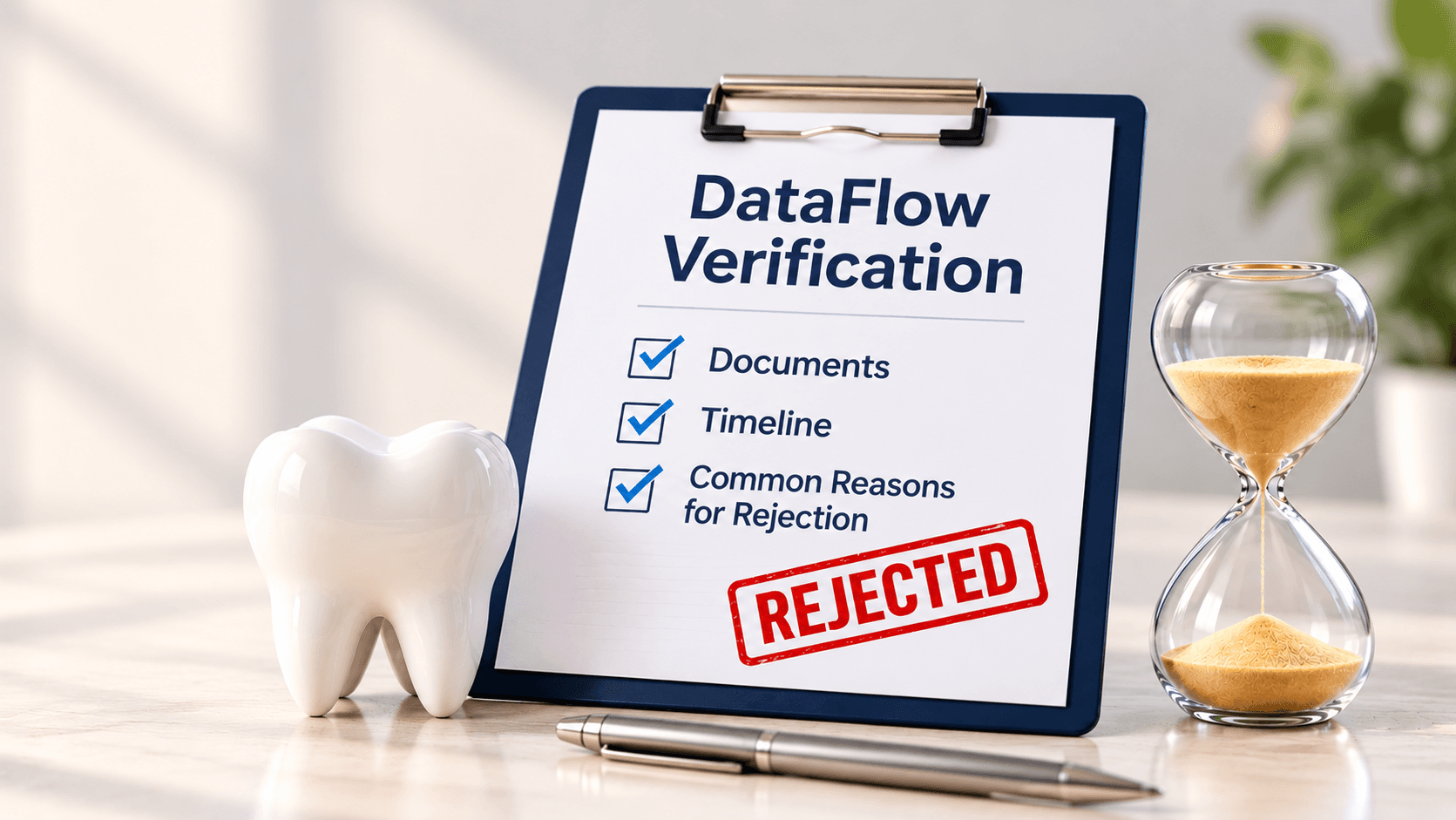
Almost every dentist applying for a licence in the Gulf hits the same wall at the same point. The exam is the part everyone prepares for. DataFlow is the part that actually delays people - often by months, and almost always for reasons that were avoidable.
DataFlow Group carries out primary source verification (PSV) on behalf of health regulators including the Dubai Health Authority, the Department of Health Abu Dhabi, MOHAP and Qatar's QCHP, among others. This guide explains what the process checks, what you need to submit, why reports stall, and how transfer between regulators works.
If you are preparing for the examination itself, see our complete guide to the DHA exam and our overview of the Gulf Prometric dental exams.
What primary source verification actually is
PSV is not a document check. Nobody at DataFlow is looking at your scanned degree and deciding whether it looks genuine.
Instead, DataFlow contacts the issuing institution directly - your dental college, your dental council, each previous employer - and asks them to confirm that the document they issued is authentic and that the details match. The report reflects what those sources say back.
This single fact explains almost everything about the process. Your timeline is not controlled by DataFlow, and it is not controlled by you. It is controlled by how quickly a university registrar's office in another country answers an email, and whether the clinic you worked at four years ago still exists.
That is why two candidates who submit identical-looking applications on the same day can finish six months apart.
What you typically need to submit
Requirements vary by regulator and by professional category, so always work from the current checklist on the regulator's own portal. In broad terms, dentists should expect to provide the following.
Primary dental qualification: your BDS or DDS degree certificate, and usually the transcript or mark sheets.
Postgraduate qualifications: MDS, diploma or fellowship certificates where you are applying for a specialist category.
Registration or licence: your dental council registration certificate from your home country, and any current practising licence, valid at the time of application.
Experience certificates: employment letters from each relevant employer, on letterhead, signed and stamped, stating your exact designation, full-time or part-time status, and precise start and end dates.
Passport: the data page, matching the name used on every other document.
Good standing certificate, where the regulator requires one.
The experience certificates are where most applications go wrong, and they are the one element entirely within your control before you submit.
Why reports get rejected or stall
Name mismatches. Your degree says one spelling, your passport another, your registration a third - an initial expanded here, a surname order reversed there. Sources cannot confirm a document for a person whose name does not match. Resolve this before applying, with an affidavit or correction where needed.
Experience letters that say nothing verifiable. A letter reading only that Dr X worked with us as a dentist is not verifiable. It must carry exact dates, designation, employment type, institutional letterhead, an authorised signature with name and position, and contact details the verifier can actually reach.
Unreachable sources. A clinic that has closed, a hospital that has been taken over, a university department whose contact email bounces. If you know a past employer is defunct, gather what proof you can in advance and declare it early rather than waiting for the report to stall.
Non-responsive institutions. Some universities are simply slow. Following up personally with your college registrar - politely and repeatedly - genuinely moves applications.
Gaps and overlaps in the employment timeline. Unexplained gaps invite queries. Overlapping full-time roles at two employers invite worse.
Documents in a language other than English without certified translation.
Wrong professional category. Applying under a specialist category your qualifications do not support will fail against the regulator's requirements, not against DataFlow.
How long it takes
There is no honest single answer, and any source quoting a fixed number is guessing. A clean application with responsive sources can complete in a few weeks. An application with an unresponsive university, a closed employer or a name discrepancy can run for months.
Plan on the assumption that it will take longer than you were told, and start it early. Specifically: start DataFlow in parallel with your examination preparation, not after you pass. Candidates who wait for a result before beginning verification routinely lose a quarter of a year for no reason at all.
Fees are set per package and per number of documents and are revised periodically. Take them from the regulator's or DataFlow's current published schedule rather than from a blog post.
Report transfer between regulators
If you already hold a completed DataFlow report for one Gulf regulator and later apply to another - say you verified for DHA and now want to apply to DOH Abu Dhabi or MOHAP - you may be able to transfer the existing report rather than repeat the whole verification.
Transfer is not automatic and is not always as cheap as it first appears. It depends on the age of the original report, whether the receiving regulator accepts it, and whether you have since added qualifications or employment that were not in the original. Any new document still has to be verified from scratch.
The practical advice is to decide early which regulators you realistically might apply to, and verify the fullest set of documents the first time. Adding documents later is slower and more expensive than including them up front.
A sensible sequence
Audit your documents first. Lay out passport, degree, transcript, registration and every experience letter side by side and check that the name matches on all of them. Fix mismatches before you spend anything.
Fix weak experience letters while you still have the relationship. Go back to each employer and ask for a letter with exact dates and designation on letterhead. This is far easier before you apply than after a report has stalled.
Start verification early, in parallel with exam preparation.
Prepare for the examination properly in the meantime. Our DHA, DOH (HAAD), MOHAP, QCHP, OMSB, NHRA, Kuwait MOH and Saudi SDLE test series each cover the relevant regulator's examination with timed mock tests and subject analytics.
Keep copies of everything, including every email to a registrar.
Related reading: our complete guide to the DHA exam, the Gulf Prometric dental exams overview, and the UAE dental licence comparison of DHA, DOH Abu Dhabi and MOHAP.