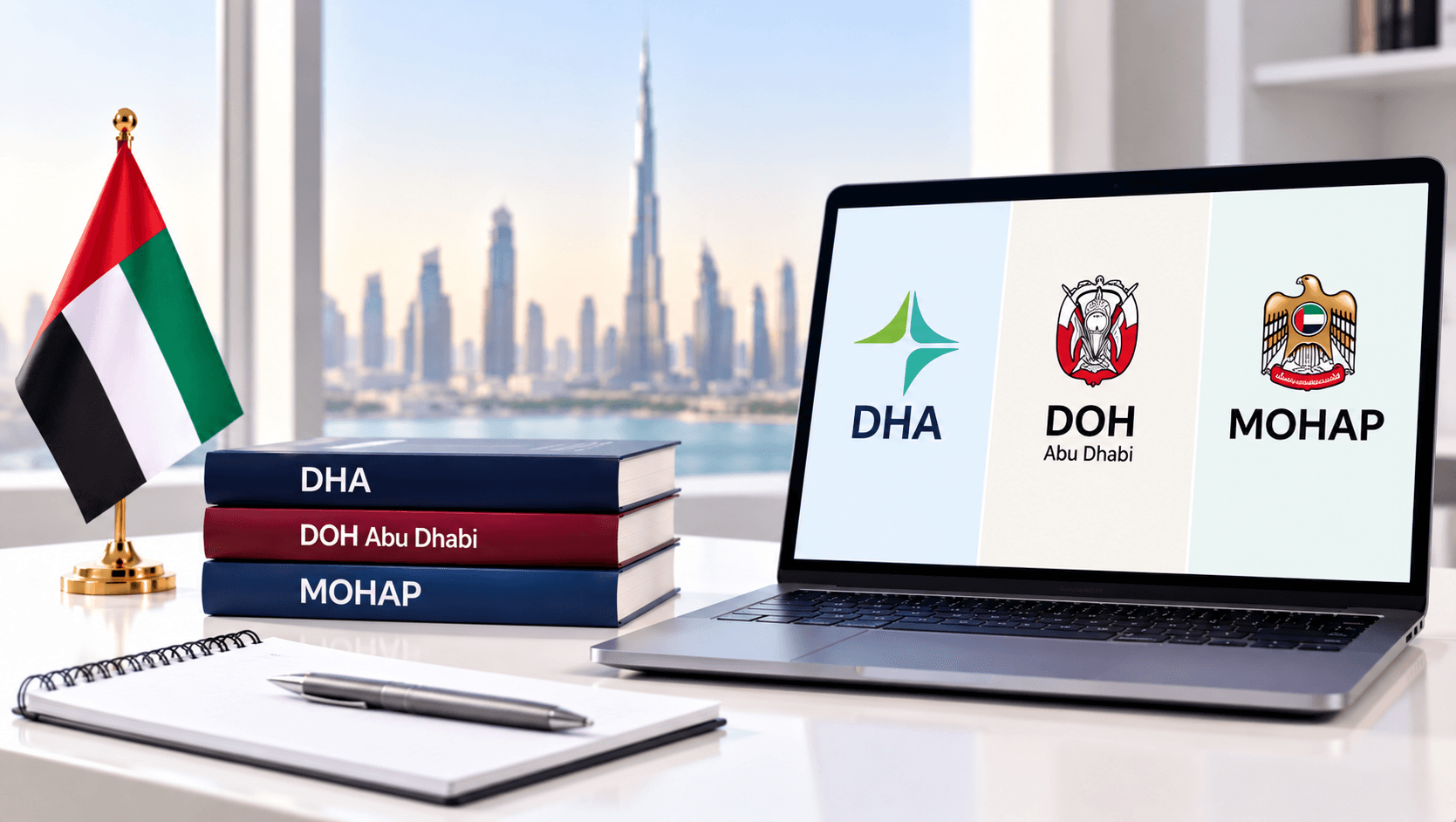
UAE Dental Licence: DHA vs DOH Abu Dhabi vs MOHAP Compared
Getting a UAE dental licence starts with a question that confuses many Indian dentists: which authority should I apply to? Unlike many countries with a single national dental council, the United Arab Emirates has three main health regulators for professional licensing: the Dubai Health Authority (DHA), the Department of Health Abu Dhabi (DOH) and the Ministry of Health and Prevention (MOHAP).
Each authority licenses dentists for a different geographical area and runs its own application system. The good news is that they share a common qualification framework, so the core eligibility rules are similar. This guide compares the three routes, explains what they have in common and helps you decide where to start. Always confirm the latest requirements with the relevant regulator, as policies are updated regularly.
Which Authority Licenses Dentists in Each Emirate?
1. DHA: Dubai
The Dubai Health Authority licenses healthcare professionals working in Dubai, including dentists in private clinics and hospitals. Applications are made online through the Sheryan portal.
2. DOH: Abu Dhabi
The Department of Health Abu Dhabi, formerly known as the Health Authority Abu Dhabi (HAAD), regulates healthcare in the Emirate of Abu Dhabi, including Al Ain and the Al Dhafra region. Many dentists still search for the HAAD exam, but the regulator is now DOH, and its licensing services are accessed through the Abu Dhabi government platforms, including TAMM.
3. MOHAP: the Northern Emirates
The UAE Ministry of Health and Prevention licenses healthcare professionals in the Northern Emirates, generally covering Sharjah, Ajman, Umm Al Quwain, Ras Al Khaimah and Fujairah. MOHAP applications are made through the ministry's online services.
In simple terms, the authority you need depends on where your future employer is located. A clinic in Dubai needs DHA-licensed dentists, a clinic in Abu Dhabi needs DOH licensing, and a clinic in Sharjah or Ajman usually needs MOHAP licensing.
What Do DHA, DOH and MOHAP Have in Common?
All three regulators use the Unified Healthcare Professional Qualification Requirements (PQR). The PQR defines the professional titles, such as General Dentist or Specialist, together with the minimum qualification, experience, licensure and good-standing requirements for each. For Indian dentists, this typically means a recognised BDS degree, current registration with the Dental Council of India or a State Dental Council, clinical experience as specified in the PQR and a certificate of good standing.
All three also rely on primary source verification. Your degree, registration and experience letters are verified directly with the issuing institutions, commonly through DataFlow Group. Finally, each authority uses a professional assessment, typically a computer-based multiple-choice exam, to confirm clinical knowledge before a licence is granted.
Because the underlying framework is shared, your preparation for one UAE dental exam overlaps heavily with the others. The same clinical subjects, from endodontics and prosthodontics to pharmacology and medical emergencies, form the core of each assessment.
How Do the Three Licensing Routes Differ?
The main differences are practical rather than academic. Each authority has its own portal, document checklist, fee structure, exam booking arrangements, eligibility validity period and rules on the number of attempts. Processing times also vary depending on demand and the completeness of your application.
Assessment delivery can differ too. DHA exams are delivered as a computer-based test through Prometric, and the other authorities also use computer-based assessments delivered through approved testing arrangements. Check each regulator's current candidate information for the exam format, test centres, validity of results and any interview or oral assessment requirements.
Licence activation is linked to employment in all three systems. You can often obtain eligibility or pass the exam before securing a job, but the licence is generally activated when you join a facility licensed by that authority. Some regulators have arrangements that can simplify moving between emirates, but these change over time, so do not assume a licence from one authority automatically allows you to work under another.
How Do You Choose Between DHA, DOH and MOHAP?
1. Follow the job market
If you already have an offer or strong contacts in a particular emirate, apply to that emirate's regulator. Your employer's HR or licensing team can often guide you on the exact title and documents required.
2. Consider where you want to live
Dubai and Abu Dhabi have the largest concentrations of private clinics, while the Northern Emirates can offer different opportunities and living costs. Think about lifestyle as well as licensing.
3. Keep your documents ready for any route
Because verification and PQR criteria are similar, well-organised documents make it easier to apply to a second authority later if your plans change.
4. Prepare once, broadly
A strong preparation strategy based on clinical MCQs and timed mock tests will serve you for any UAE dental licensing exam.
What Are Common Mistakes to Avoid?
The most common problems are avoidable. Name mismatches across passports, degree certificates and registration documents can delay verification, so resolve these before applying. Experience letters should state your designation, dates of employment and full or part-time status clearly on official letterhead.
Another frequent mistake is choosing the wrong professional title, for example applying as a specialist without meeting the PQR criteria for that title. Finally, some candidates book the exam too early and use up an attempt before they are ready. Take a realistic mock test first and book only when your scores are consistently strong.
Frequently Asked Questions
Is the HAAD exam the same as the DOH exam?
Yes, in practical terms. HAAD was the former name of the Abu Dhabi health regulator, which is now the Department of Health Abu Dhabi. Dentists seeking an Abu Dhabi licence now apply to DOH.
Can I apply to more than one UAE authority?
Many dentists do, especially while searching for jobs. Each authority has its own process and fees, so plan carefully and check whether any recognition arrangements apply to your situation.
Is the syllabus different for DHA, DOH and MOHAP exams?
The core clinical subjects are similar because all three assess the knowledge expected of a safe general dentist. Always review each authority's current candidate guidance for any specific emphasis.
Do I need experience after BDS to apply?
The PQR specifies experience requirements for each professional title. Check the current PQR carefully, as requirements can vary with your qualification and title.
Do I need a job offer to take the exam?
Usually you can start eligibility and assessment without an offer, but licence activation generally requires employment with a licensed facility in that emirate.
Conclusion
Choosing the right route to a UAE dental licence becomes simpler once you understand that DHA covers Dubai, DOH covers Abu Dhabi and MOHAP covers the Northern Emirates, all under a shared qualification framework. Focus on the emirate where you want to work, prepare your documents carefully and build your exam preparation on consistent MCQ practice.
MCDI supports dentists with preparation for DHA, DOH and MOHAP dental exams, a dental MCQ test series with timed mock tests, and documentation assistance for international dental registration. Get in touch with the MCDI team to plan your UAE licensing journey.