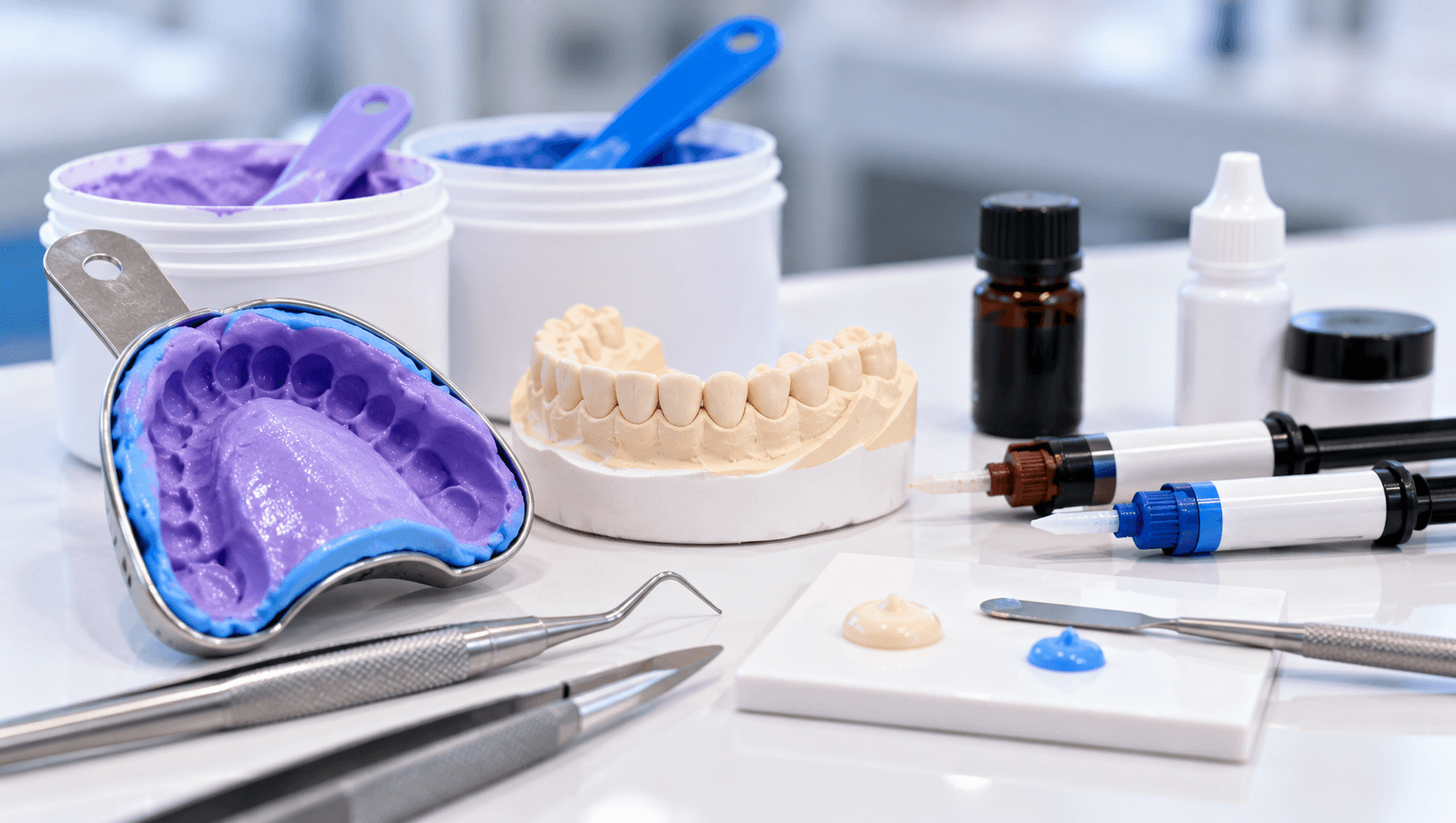
Most material failures in general practice are not failures of the material. They are failures of selection or handling - the right cement used in the wrong indication, an impression material contaminated by a glove, a composite cured through too thick an increment.
Manufacturers publish instructions that are followed loosely because the differences seem small. They are not. The gap between a restoration that lasts twelve years and one that fails in two is often a matter of a few seconds of etch time or a millimetre of increment thickness.
This guide covers the three material groups that most affect daily outcomes, how to choose within each, and the handling details that determine whether they perform.
Impression materials
Alginate. An irreversible hydrocolloid: inexpensive, hydrophilic, comfortable, and dimensionally unstable. It is excellent for study models, opposing arches, orthodontic records and provisional fabrication, and unsuitable for fixed prosthodontic working impressions. The critical handling point is that it must be poured promptly - syneresis and imbibition distort it within a short time, and an alginate poured the following morning is a different shape from the mouth it came from. Store wrapped in a damp towel only if a short delay is unavoidable, and never in water.
Polyvinyl siloxane, also called addition silicone. The workhorse for crown and bridge. Excellent dimensional stability and elastic recovery, good detail reproduction, pleasant for the patient, and available in a range of viscosities and setting times. Its one well-known vulnerability is inhibition of polymerisation by sulphur - latex gloves, some retraction cords and some haemostatic agents. Handle putty with vinyl or nitrile gloves, or wash and dry your gloves thoroughly, and rinse the preparation properly after using a haemostatic agent. Hydrophilic formulations tolerate moisture better than earlier materials but do not replace proper field control.
Polyether. Outstanding detail, intrinsically hydrophilic, and highly accurate - which makes it a strong choice for implant impressions and for preparations with subgingival margins where some moisture is unavoidable. It is rigid when set, which can make removal difficult with undercuts and splinted abutments, and it absorbs water, so it must not be stored in disinfectant for prolonged periods. The taste is unpopular with patients.
Zinc oxide eugenol and impression compound retain specific roles in complete denture work, discussed in our article on complete denture impressions.
Choose by indication: alginate for records, polyvinyl siloxane for most fixed work, polyether where detail and hydrophilicity matter most.
Cements and luting agents
This is where selection errors are most common, because several materials will appear to work in the short term.
Zinc phosphate. The historical standard, with a long clinical record. High compressive strength, no chemical adhesion, and an initially low pH requiring pulpal protection in deep preparations.
Glass ionomer cement. Chemically bonds to tooth structure, releases fluoride, has good biocompatibility, and is moisture sensitive during setting. Useful for luting metal and metal-ceramic restorations, for cervical restorations in high-caries-risk patients, and as a base.
Resin-modified glass ionomer. Combines fluoride release and chemical adhesion with improved strength and reduced moisture sensitivity. A good general-purpose luting cement for metal-ceramic and zirconia crowns with adequate retention form. It expands slightly on setting, which has historically counselled caution with brittle all-ceramic restorations.
Resin cements. The strongest, and essential wherever the restoration relies on adhesion rather than mechanical retention - veneers, inlays and onlays, lithium disilicate restorations, and short or over-tapered preparations. They require meticulous isolation and a multi-step adhesive protocol, and they are technique sensitive in direct proportion to their strength. Available in light-cured, dual-cured and self-cured forms; use light-cured only where the restoration is thin enough to transmit adequate light.
Self-adhesive resin cements. A pragmatic compromise, combining reasonable strength with a simplified protocol and no separate etching or bonding step. Convenient for zirconia and metal crowns with good retention form; not the first choice for veneers.
The governing rule: where retention comes from preparation geometry, a conventional cement is sufficient. Where retention depends on adhesion, use a resin cement and accept the isolation discipline that goes with it. And match the surface treatment to the restoration - hydrofluoric acid and silane for glass ceramics, air abrasion and a phosphate monomer primer for zirconia. Etching zirconia with hydrofluoric acid achieves nothing.
Composites and adhesion
Composite selection has become a matter of matching filler technology and handling characteristics to the clinical situation rather than chasing a single best material.
Microhybrid and nanohybrid composites are the general-purpose materials for most anterior and posterior restorations, combining acceptable strength with good polishability.
Bulk-fill composites allow increments up to around 4 mm, reducing placement time in deep posterior cavities. Depth of cure claims should be respected rather than exceeded, and many clinicians cap a bulk-fill base with a conventional composite occlusal layer for better wear and polish.
Flowable composites are useful as a thin initial layer in deep boxes to adapt to the cavity floor, and for small cavities, but their lower filler content means they should not be used in bulk in stress-bearing areas.
Glass ionomer and resin-modified glass ionomer remain valuable where moisture control is poor, in high-caries-risk patients, for the atraumatic restorative technique, and for deciduous teeth.
On adhesives, the practical points that matter more than the generation number: follow the specified etch time, which is typically around 15 seconds on enamel and shorter on dentine; do not desiccate dentine after etching, because collapsed collagen cannot be infiltrated; agitate the primer or adhesive rather than painting it on passively; thin the adhesive gently with air to avoid pooling; and cure for the full recommended time.
Selective enamel etching with a self-etch adhesive is a reasonable modern compromise, giving reliable enamel bonding with lower postoperative sensitivity risk than total-etch on dentine.
The handling errors that cause most failures
Curing light output that has never been measured. Light output degrades, tips get contaminated with composite, and a light the operator assumes is adequate frequently is not. Use a radiometer, clean the tip, and hold it perpendicular and as close as the anatomy allows. Increasing exposure time does not compensate for distance, because irradiance falls off sharply.
Increments that are too thick. Depth of cure is a property of the material and the light, not of optimism.
Contamination. Saliva, blood, haemostatic agents and latex, each with its own consequence.
Mixing ratios and timing ignored. Hand-mixed materials are proportioned by eye more often than anyone admits.
Expired or badly stored materials. Composites and adhesives stored in a hot surgery degrade; bonding agents left uncapped evaporate their solvent.
Failure to respect working and setting times, particularly in impressions removed before full elastic recovery.
Wrong cement for the retention situation.
Inadequate isolation for adhesive procedures. A rubber dam is the single highest-return habit in restorative dentistry and the most commonly skipped. See our article on rubber dam isolation.
A useful audit: take your three most-used materials and read the current instructions for use in full. Most clinicians find at least one step they have been doing differently for years.
Our Online Dental Materials Course covers the materials used in general practice in depth, and our Restorative Dentistry courses cover composite and adhesive technique hands-on. Our Dental Materials Test Series covers the subject for BDS, MDS and licensing examinations.
Related reading: our articles on rubber dam isolation, tooth preparation for crowns, and complete denture impressions.