Rotary Endodontics: Complete Guide to Modern Root Canal Treatment
Introduction
Root canal treatment (RCT) has evolved remarkably over the past few decades, transforming from a complex and time-consuming procedure into a predictable, efficient, and patient-friendly treatment. One of the most significant advancements in modern dentistry is Rotary Endodontics, which utilizes engine-driven nickel-titanium (NiTi) rotary files to clean and shape root canals with exceptional precision. This technology has improved clinical outcomes while reducing treatment time and enhancing patient comfort. At Master Clinical Dentistry Institute, we emphasize evidence-based learning and hands-on clinical training to help dentists master rotary endodontics with confidence.
What is Rotary Endodontics?
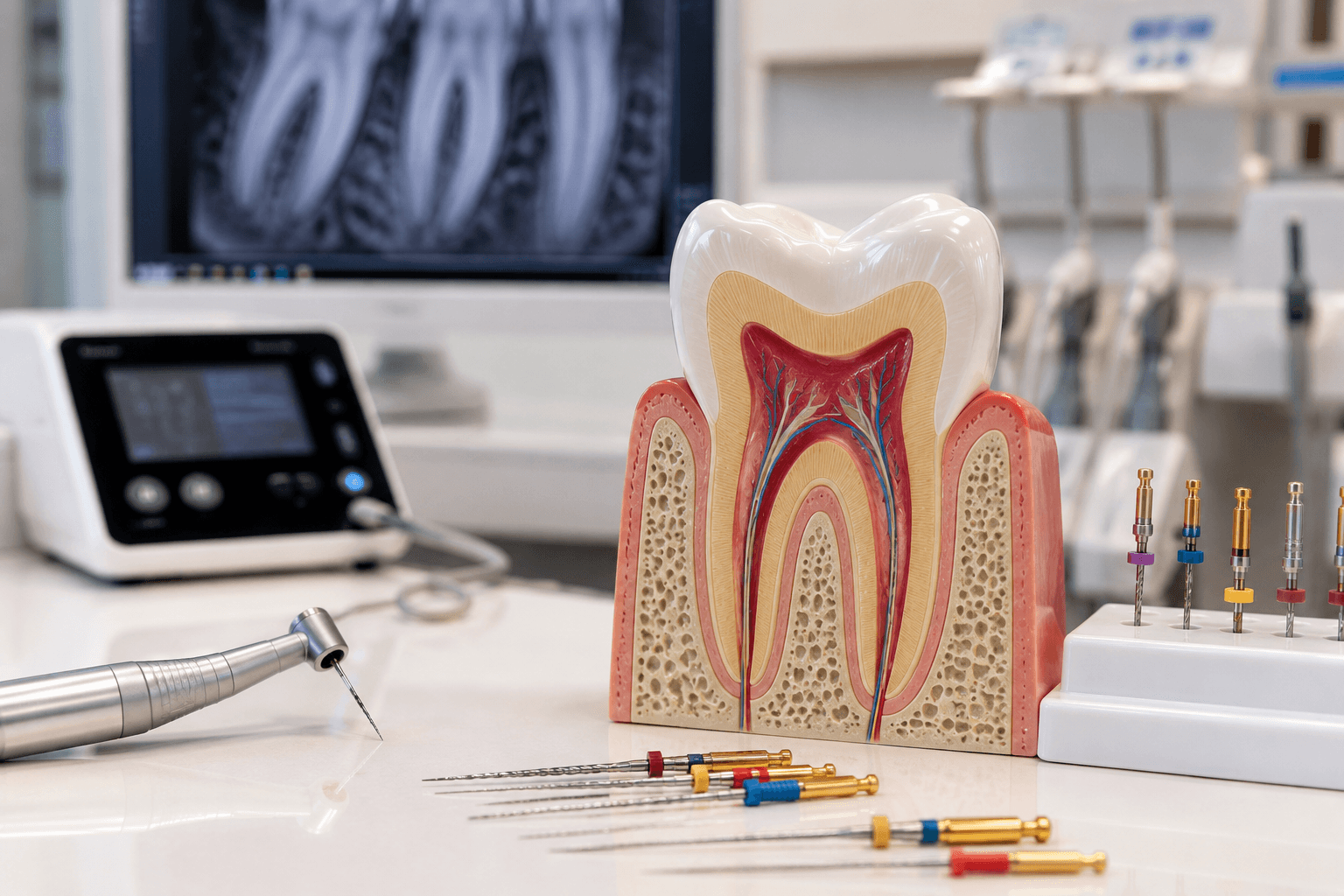
Rotary endodontics is an advanced method of root canal preparation that uses nickel-titanium rotary instruments powered by an endodontic motor. Unlike conventional stainless-steel hand files, NiTi rotary files are highly flexible and capable of negotiating curved canals while preserving the natural canal anatomy. The primary objectives of rotary instrumentation are to remove infected pulp tissue, eliminate bacteria, create a continuously tapered canal, facilitate effective irrigation, and prepare the canal for a three-dimensional obturation.
Advantages of Rotary Endodontics
Rotary endodontics offers numerous advantages over traditional hand instrumentation. It significantly reduces treatment time, preserves the original canal anatomy, minimizes the risk of canal transportation and perforation, and improves patient comfort by shortening chairside procedures. The consistent canal taper achieved with rotary files enhances irrigation and obturation, leading to more predictable long-term clinical success. Additionally, rotary instrumentation reduces operator fatigue and improves ergonomics, making it easier for dentists to perform multiple endodontic procedures efficiently.
Essential Equipment for Rotary Endodontics
Successful rotary endodontic treatment requires specialized equipment, including an endodontic motor, electronic apex locator, nickel-titanium rotary files, rubber dam kit, irrigation syringes, sodium hypochlorite, EDTA solution, paper points, gutta-percha cones, and root canal sealer. Each component plays a crucial role in achieving effective canal disinfection, accurate working length determination, and a well-sealed obturation.
Clinical Protocol for Rotary Endodontics
A successful rotary endodontic procedure begins with an accurate diagnosis based on patient history, clinical examination, pulp vitality testing, percussion tests, and radiographic evaluation. Rubber dam isolation is considered the gold standard for preventing contamination and improving visibility. A properly designed access cavity ensures straight-line access and reduces stress on rotary files. Working length should be determined using an electronic apex locator and confirmed radiographically when necessary. Before introducing rotary files, a glide path should always be established using small hand files to minimize torsional stress and reduce the risk of file separation. Rotary instrumentation should follow the manufacturer's recommended sequence using gentle pressure, frequent irrigation, and regular cleaning of file flutes. Finally, the canal should be thoroughly irrigated, dried, and obturated with gutta-percha and an appropriate root canal sealer to achieve a bacteria-tight seal.
Common Mistakes to Avoid
Many clinicians encounter avoidable complications due to improper technique. Skipping glide path preparation increases the likelihood of rotary file fracture, while inadequate irrigation leaves bacteria and tissue remnants inside the canal. Excessive pressure on rotary instruments can lead to instrument separation, and poor access cavity preparation places unnecessary stress on files. Reusing worn or fatigued instruments beyond the manufacturer's recommendations further increases the risk of file fracture and treatment failure.
Prevention of Rotary File Separation
Instrument separation remains one of the most concerning complications in rotary endodontics. This risk can be minimized by establishing a proper glide path, using the correct torque and speed settings, avoiding excessive apical pressure, cleaning file flutes frequently, inspecting instruments before every use, and replacing files according to manufacturer guidelines. Careful adherence to these principles significantly improves treatment safety and clinical success.
Recent Advances in Rotary Endodontics
Modern endodontics continues to advance with innovations such as heat-treated nickel-titanium files, reciprocating systems, single-file rotary systems, improved metallurgy, Cone Beam Computed Tomography (CBCT), ultrasonic irrigation, bioceramic sealers, and digital apex locators. These technologies have enhanced the efficiency, safety, and predictability of root canal treatment while simplifying complex clinical procedures.
Clinical Tips for Beginners
Dentists who are new to rotary endodontics should practice on extracted teeth before treating patients, thoroughly understand root canal anatomy, always use rubber dam isolation, never compromise on irrigation, maintain straight-line access, follow evidence-based clinical protocols, and attend structured hands-on workshops. These practices build confidence, improve tactile sensation, and reduce the risk of procedural errors.
Importance of Hands-on Training
While textbooks and online videos provide valuable theoretical knowledge, they cannot replace practical clinical experience. Hands-on training enables dentists to understand tactile feedback, master rotary file sequences, manage clinical complications, and perform root canal treatment with greater confidence. At Master Clinical Dentistry Institute, participants receive expert-guided clinical training that bridges the gap between theory and practice, allowing them to confidently incorporate rotary endodontics into their daily clinical workflow.
Frequently Asked Questions
Rotary endodontics is generally considered superior to conventional hand instrumentation because it offers faster treatment, improved canal shaping, greater efficiency, and better preservation of natural canal anatomy. Beginners can successfully learn rotary endodontics with proper guidance, supervised practice, and structured clinical training. Rubber dam isolation is strongly recommended for every root canal procedure because it prevents contamination, enhances visibility, and improves patient safety. Although rotary files provide excellent canal shaping, irrigation remains essential, as mechanical instrumentation alone cannot completely eliminate bacteria from the complex root canal system.
Conclusion
Rotary endodontics has become the standard of care for modern root canal treatment by improving efficiency, precision, and long-term clinical outcomes. Advances in nickel-titanium metallurgy, endodontic motors, irrigation systems, and obturation materials have enabled dentists to provide safer and more predictable treatment than ever before. However, successful endodontics depends not only on advanced technology but also on accurate diagnosis, proper clinical protocols, careful case selection, and continuous professional education. Through comprehensive hands-on training at Master Clinical Dentistry Institute, dentists can develop the practical skills and confidence needed to deliver high-quality root canal treatment, improve patient satisfaction, and build a successful modern dental practice.