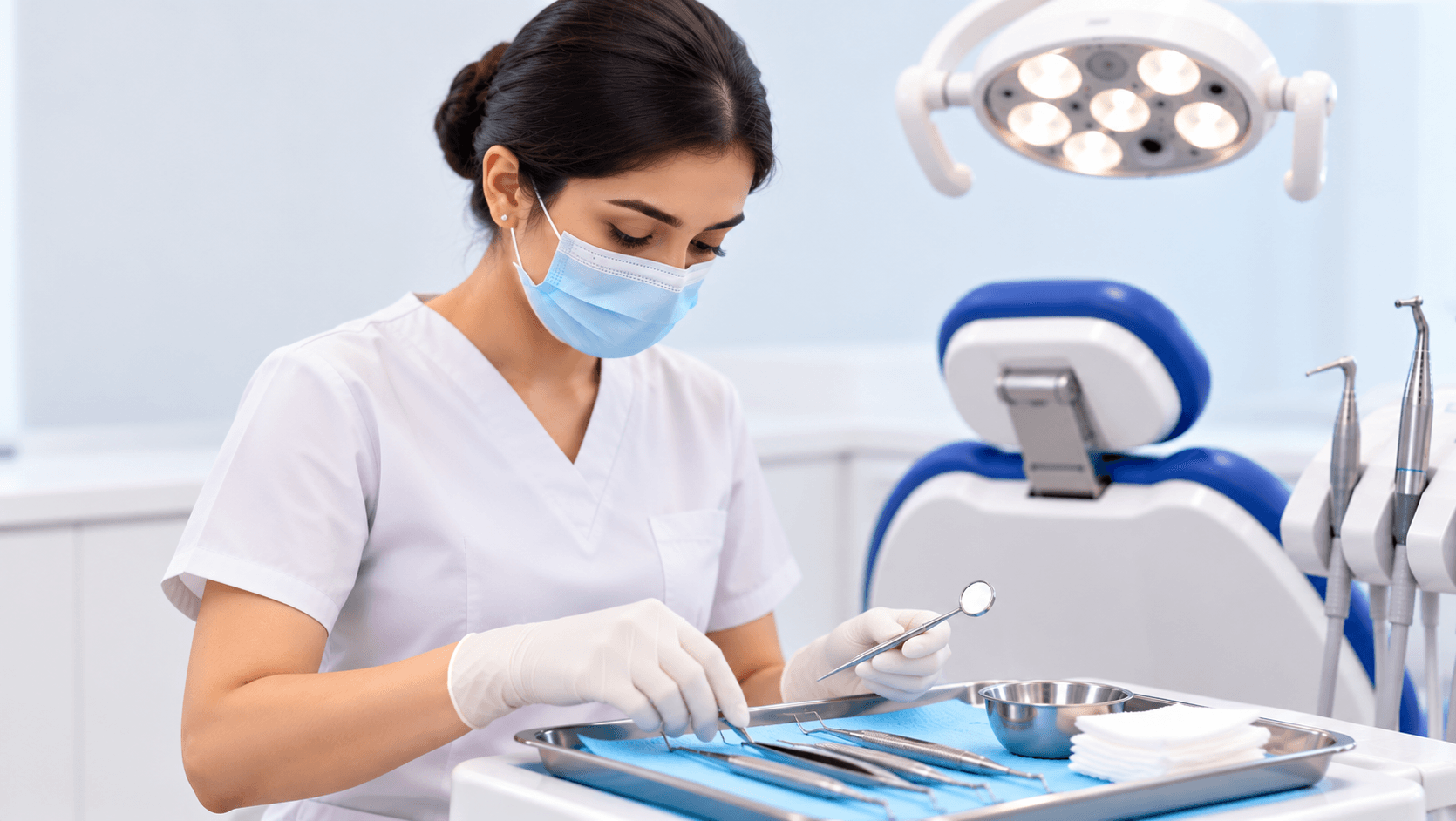
Dental assisting is the most accessible entry point into clinical dentistry. In most systems it requires months rather than years of training, has consistent employment demand, and places you in a clinical environment from the first week.
It is also the role with the widest variation in what the job actually means. In some countries a dental assistant passes instruments and manages infection control; in others they take radiographs, place and finish restorations under supervision, and apply sealants. The title tells you very little without the jurisdiction attached.
This guide explains the routes in, the certifications that matter, what the work genuinely involves, and where it leads.
What the role involves
The core of chairside assisting is making the operator faster and the patient safer.
That means four-handed dentistry - anticipating the next instrument rather than responding to a request, maintaining a clear field with suction and retraction, and keeping the operator's eyes in the mouth and hands in position.
It also means instrument identification and tray set-ups for each procedure; mixing and handling materials to working time; moisture control and isolation including rubber dam assistance; charting and record-keeping; sterilisation and instrument reprocessing; stock control; patient reception, reassurance and post-operative instruction; and assisting in medical emergencies.
In expanded-function roles, depending on jurisdiction and additional certification, the work may include taking and processing radiographs, taking impressions and scans, placing and removing rubber dam, applying fluoride and sealants, coronal polishing, placing and finishing restorations under direct supervision, and orthodontic procedures such as archwire ligation and bracket removal.
The two attributes that make an excellent assistant are anticipation and consistency. Neither is taught in a classroom; both develop with volume.
Training routes by country
In the United States, routes range from on-the-job training in some states to formal programmes accredited by the Commission on Dental Accreditation, typically around nine to eleven months for a certificate or diploma, with associate degree options. What an assistant may do, and what credential is required to do it, is set state by state.
The Certified Dental Assistant credential, awarded by the Dental Assisting National Board, is the widely recognised national certification and is required or preferred in many states. Radiography permits are frequently a separate requirement and the one most assistants need first.
In the United Kingdom the role is called dental nurse. Qualification is through a recognised dental nursing course leading to registration with the General Dental Council, commonly studied part-time alongside a trainee post in practice.
In Australia, dental assistants may enter through a certificate-level vocational qualification, with additional units for radiography and other expanded functions.
In India, dental assistant courses are offered as certificate and diploma programmes. The role is less formally regulated than in the systems above, and in many practices assistants are trained in-house - which is precisely why a structured certificate course is a differentiator in the job market. Our Dental Assistant Course covers classroom training, and our Online Dental Assistant Course delivers the syllabus with certification remotely.
Certification and radiography permits
For most assistants the credential that changes what you can do day to day is the radiography permit, because taking radiographs is both high-value and tightly regulated.
Beyond that, expanded-function certification - under various names in different systems - is what separates an assistant who holds instruments from one who performs delegated clinical procedures. It is usually the largest single step in both responsibility and earnings available within the role.
Infection control certification is required in several jurisdictions and is worth holding everywhere. Our Online Infection Control Course for Dental Practice covers sterilisation, disinfection and instrument reprocessing to a standard that satisfies most employer requirements.
Basic life support certification is effectively mandatory in any clinical setting and should be current rather than historic. Our Medical Emergency Course covers CPR, BLS and AED hands-on.
The practical sequence for someone starting out: get qualified, get your radiography permit, get BLS, then pursue expanded functions once you have chairside volume behind you.
What the career offers
Entry is fast and training cost is low relative to other clinical roles, which is the main attraction.
Earnings are modest at entry in every system and rise meaningfully with expanded functions, with specialty experience - oral surgery, orthodontics and implant assisting generally pay more - and with seniority into lead assistant and practice coordinator roles.
Demand is consistent. Practices nearly always need assistants, and good ones are retained.
The most underrated feature of the role is that it is the best possible vantage point from which to decide whether you want a longer clinical career. An assistant sees every procedure in the practice, every day, before committing years to training.
Progressing beyond assisting
Several routes open from here, and planning for one early makes a difference.
Expanded functions within assisting, which is the shortest step and often the highest return.
Specialty assisting in oral surgery, orthodontics, implantology or paediatrics. Our Online Orthodontic Assistant Course covers bonding, archwire ligation, appliance care and debonding specifically.
Dental hygiene. Many hygiene programmes value assisting experience, and prerequisite coursework can often be completed while working. See our guide to becoming a dental hygienist.
Dental therapy or oral health therapy, which carries a wider scope including restorations and paediatric extractions. See our comparison of therapist and hygienist roles.
Practice management and treatment coordination, for assistants with strong administrative and communication skills. Our Dental Clinic Setup and Practice Management Course and Dental Receptionist Course cover that direction.
Dental laboratory technology, for those drawn to the fabrication side. See our guide to becoming a dental lab technician.
Education, product training and clinical sales roles with dental manufacturers.
The common error is treating assisting as a holding position rather than a foundation. The assistants who build the strongest careers decide within the first two years which direction they are heading, and start accumulating the credential for it.