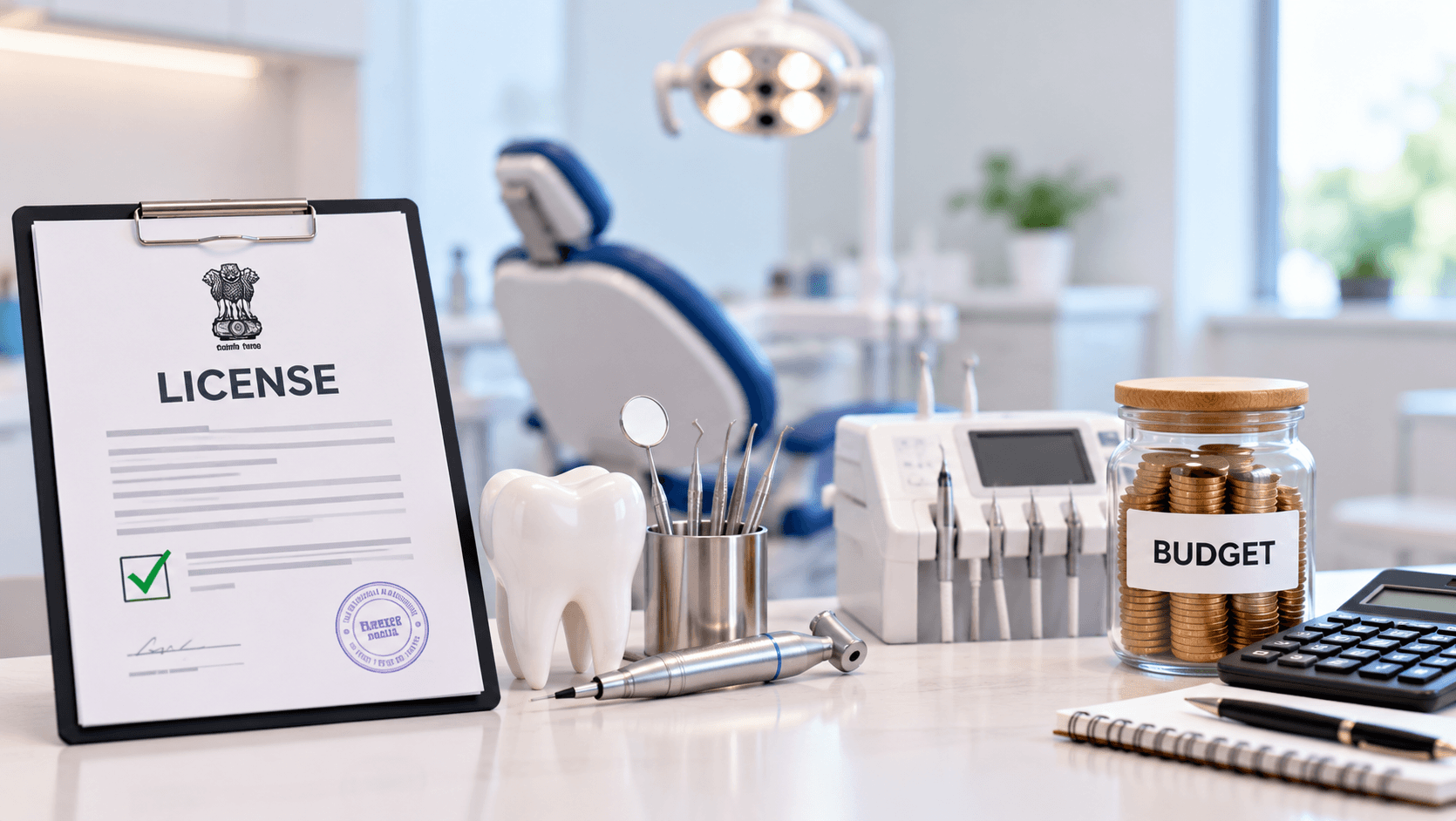
Most dentists set up their first clinic with a good sense of clinical dentistry and almost no sense of business. The result is predictable: too much capital in equipment that is rarely used, too little in location and visibility, and a cash flow problem in month seven.
This guide covers the practical sequence of opening a dental clinic in India - the legal requirements, how to choose premises, how to lay out the operatory, what to buy first and what to defer, and what the first year actually costs.
It is deliberately conservative. Nothing here will make the setup sound easier than it is.
Registrations and licences
Requirements vary by state and by municipality, so treat this as a checklist to verify locally rather than a complete list.
Dental Council registration. You must be registered with the Dental Council of India and the relevant State Dental Council, with registration current.
Clinical Establishment registration, under the Clinical Establishments Act where adopted by the state, or the state's own equivalent legislation. Requirements typically cover minimum space, staffing, equipment and record-keeping standards.
Local municipal trade licence or shop and establishment registration.
Biomedical waste authorisation from the State Pollution Control Board, with a contract in place with an authorised common biomedical waste treatment facility. This is not optional and is actively inspected.
AERB registration for dental X-ray equipment through the eLORA system, with radiation protection requirements including room shielding and personnel monitoring.
GST registration where turnover thresholds are met, bearing in mind that healthcare services have their own treatment under GST while the sale of goods does not.
Fire safety clearance where required by local rules, and professional indemnity insurance, which is strongly advisable rather than strictly compulsory.
Start the biomedical waste contract and AERB registration early. Both have lead times that surprise people.
Choosing a location
Location influences practice revenue more than equipment does, and it is the decision that is hardest to reverse.
Visibility and ground-floor access matter disproportionately in India, where a large share of early patients are walk-ins from the immediate catchment.
Assess the catchment honestly: residential density, income profile, and - critically - the number and quality of existing dental practices within walking distance. A saturated market is not necessarily wrong if you are differentiated, but it is wrong if you are not.
Parking, public transport access and the ability to be found on a map application.
Lease terms: duration, lock-in, escalation clause, and explicit written permission for clinical use and for the structural modifications you will need.
Check the water supply, electrical load and drainage before signing. Retrofitting electrical capacity for a compressor, autoclave and chair is expensive and sometimes impossible.
Rent should be sized against realistic early-stage revenue, not against aspiration. Rent is a fixed cost that continues whether your appointment book is full or empty, and it is the single most common cause of first-year distress.
Layout and workflow
Design around movement. Every metre a staff member walks repeatedly is a cost.
The functional zones are reception and waiting, the operatory or operatories, a sterilisation area, a compressor and services area, records and storage, staff space, and patient toilet facilities.
The sterilisation area deserves specific attention because it is where infection control either works or does not. It needs a dirty-to-clean flow in one direction: receiving and disassembly, cleaning and ultrasonic, drying and inspection, packing, autoclave, and sterile storage. A sterilisation bench where clean and contaminated instruments share space is a design failure, and it is extremely common.
In the operatory, plan for the assistant as well as the operator. Twelve o'clock cabinetry, assistant access from the patient's left, and suction and air lines positioned for four-handed work make a measurable difference to appointment length.
Place the compressor and suction motor where noise does not reach the operatory or waiting area, with ventilation and drainage.
Plan the X-ray installation with AERB shielding requirements in mind from the beginning rather than adapting afterwards.
Allow for a second operatory even if you only fit out one. Running conduits and plumbing during the initial build is cheap; adding them later means breaking finished walls.
Equipment: what to buy first
A workable priority order for a single-chair start-up.
Essential from day one: dental chair unit with delivery system, light and assistant unit; air compressor, preferably oil-free; suction system; Class B autoclave; ultrasonic cleaner; instrument sets for examination, restorative, endodontics, periodontics and extractions; ultrasonic scaler; light cure unit; apex locator; intraoral X-ray unit with digital sensor or phosphor plate system; emergency drug kit and oxygen; and basic furniture and sterilisation infrastructure.
Add early, within the first year, as the case mix justifies: endodontic rotary motor; intraoral camera, which pays for itself in case acceptance faster than almost anything else; a second handpiece set so sterilisation never delays a procedure; and better magnification, starting with loupes.
Defer until clinical volume genuinely justifies it: CBCT, intraoral scanner, milling unit, laser, implant motor and surgical kit, and an operating microscope. These are excellent investments at the right time and dead capital at the wrong one.
The principle: buy quality in the things you touch every day and in anything that affects sterility or safety. Economise on what sits idle. A dentist with a modest chair and excellent loupes practises better dentistry than one with an elaborate chair and no magnification.
Budgeting and the first year
Build the budget in four parts and resist the temptation to compress any of them.
Capital expenditure: fit-out and civil work, equipment, furniture, signage and IT.
Deposits and legal: rent deposit, registrations, licences and professional fees.
Working capital: this is the part people underestimate. You need enough to cover rent, salaries, consumables, utilities and loan repayments for the period before the practice reaches break-even. Plan for that period to be longer than you expect - a new clinic without an inherited patient base does not fill in two months.
Personal living expenses for the same period, which must be separate from the practice account.
Keep practice and personal accounts strictly separate from day one. Track collections, not just treatment performed. Price deliberately rather than by matching the clinic down the road, and be able to justify your fee by what the patient receives.
The commonest financial errors are over-capitalising on equipment, taking premises with rent sized for a mature practice, and having no working capital buffer. All three are avoidable at the planning stage and very difficult to fix afterwards.
Staffing and systems
Start lean: one trained chairside assistant and, as volume grows, a receptionist. A well-trained assistant increases your clinical output more than any equipment purchase at this stage. Our Dental Assistant and Dental Receptionist courses cover these roles specifically.
Put systems in place before you need them: a written infection control protocol; a medical emergency protocol with the kit checked and in date, and the whole team BLS-trained; a consent process and standard record format; an appointment and recall system; and a stock reorder system.
Document patient records properly from the first patient. Retrospective record-keeping is both unreliable and indefensible. See our article on dental records, consent and documentation for what a defensible record contains.
Plan your own continuing education budget alongside the equipment budget. The clinical limitations you discover in your first year of independent practice - in endodontics, in surgical extractions, in prosthodontics - are what determine which courses you need, and addressing them promptly is what stops referrals leaving your practice.
Our Dental Clinic Setup and Practice Management Course covers clinic planning, costing, compliance and operations in a classroom format, and the Online Dental Clinic Setup and Practice Management Course covers the same material remotely.
Related reading: our guide to the best dental courses after BDS in India, and clinical dentistry skills every dentist should develop after BDS.