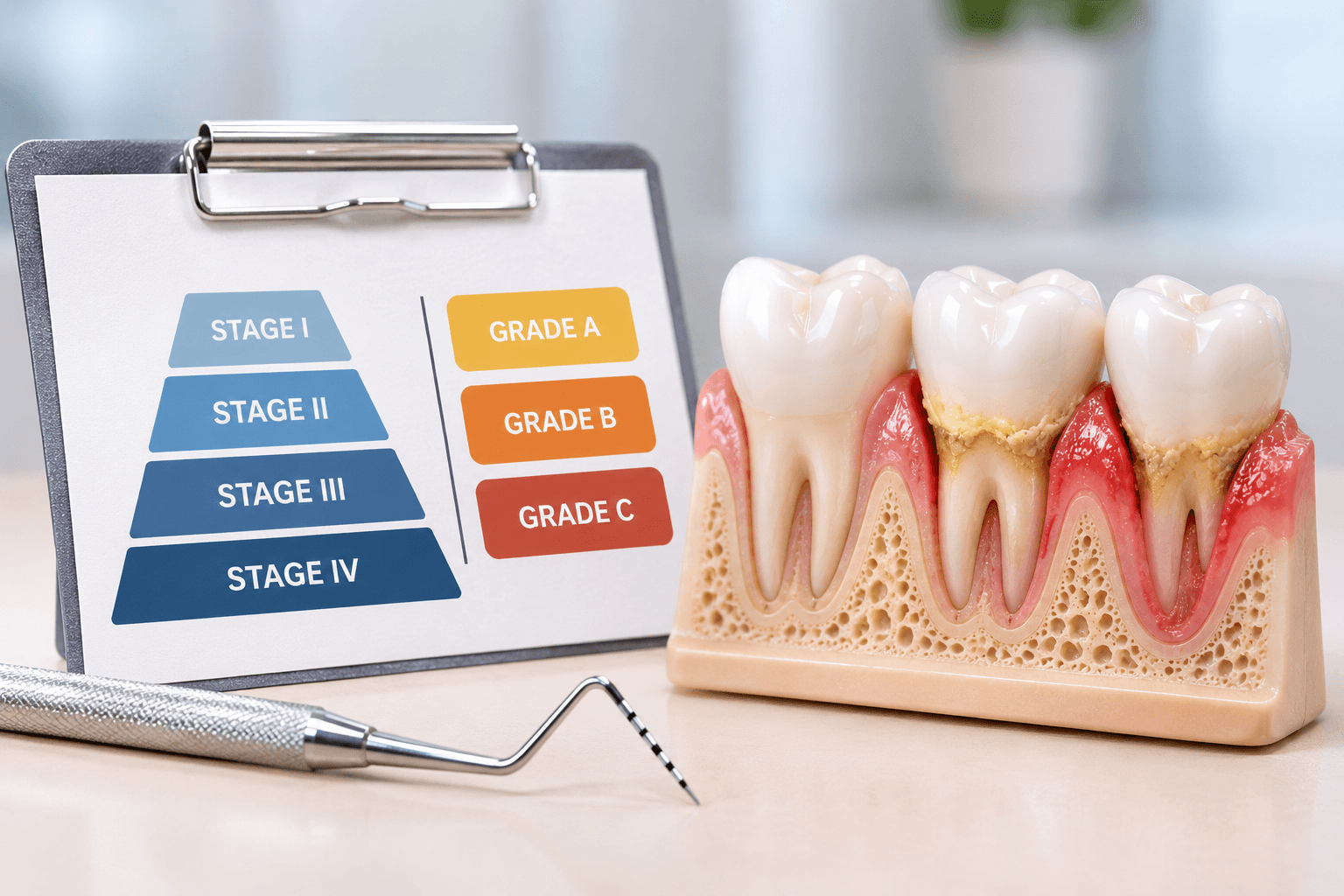
The 2017 World Workshop classification replaced a system that had been in use since 1999, and it changed more than terminology. It removed the chronic and aggressive periodontitis distinction, introduced staging and grading borrowed conceptually from oncology, defined periodontal health for the first time, and formally classified peri-implant conditions.
Several years on, a substantial number of clinicians still write chronic generalised periodontitis on their notes. That is not merely out of date - it conveys less information than the current system, and in examination settings it is marked as incorrect.
This guide explains how to apply the classification in practice, and how to write a complete diagnosis.
Why the chronic and aggressive distinction was abandoned
The 1999 system separated chronic from aggressive periodontitis largely on the basis of rate of progression and age of onset.
In practice the distinction proved unreliable. The two entities could not be consistently differentiated on pathophysiology, the diagnosis often changed as the patient aged, and clinicians applied the criteria inconsistently. Crucially, the label did not reliably predict how the patient would respond to treatment.
The 2017 system replaced it with a single disease - periodontitis - described along two independent axes: stage, which captures severity and complexity, and grade, which captures the risk of future progression. Rate of progression, which was the real content of the aggressive label, is now captured in the grade.
Staging: severity and complexity
Stage is determined primarily by interdental clinical attachment loss at the site of greatest loss, supported by radiographic bone loss and tooth loss attributable to periodontitis.
Stage I is initial periodontitis, with minimal attachment loss and bone loss confined to the coronal third of the root.
Stage II is moderate periodontitis, with greater attachment loss, still with bone loss in the coronal third, and management that remains essentially non-surgical.
Stage III is severe periodontitis with potential for additional tooth loss. Bone loss extends to the middle third of the root or beyond. Complexity factors appear: probing depths of 6 mm or more, vertical bone defects of 3 mm or more, furcation involvement of Class II or III, and moderate ridge defects.
Stage IV is advanced periodontitis with potential for loss of the dentition. In addition to Stage III features, there is masticatory dysfunction, secondary occlusal trauma, drifting and flaring, bite collapse, severe ridge defects, or fewer than 20 remaining teeth - that is, fewer than 10 opposing pairs.
Two modifiers complete the stage. Extent: localised when fewer than 30 per cent of teeth are involved, generalised when 30 per cent or more, or a molar-incisor pattern. And complexity factors, which can raise the stage even when attachment loss alone would place the patient lower - this is the point most often missed. A patient with moderate attachment loss but Class II furcations is not Stage II.
An important practical rule: once staged, a patient does not go down a stage after successful treatment. Stage reflects lifetime severity and the complexity of managing that patient, not current inflammation.
Grading: risk of progression
Grade estimates the rate of progression and the likely future risk, and it is where the patient's biology and behaviour enter the diagnosis.
The primary criterion is the ratio of radiographic bone loss to the patient's age, used where direct evidence of progression over time is unavailable.
Grade A indicates a slow rate of progression, Grade B a moderate rate, and Grade C a rapid rate.
Grade modifiers then adjust this. Smoking: ten or more cigarettes per day shifts the patient toward Grade C. Diabetes: an HbA1c of 7.0 per cent or above in a patient with diabetes does the same.
The clinical value of grading is that it drives recall interval and the intensity of risk-factor intervention. A Grade C patient needs shorter recall, more aggressive smoking cessation support and closer liaison with their physician about glycaemic control. A Grade A patient does not need the same intensity. Staging tells you what you are treating; grading tells you how hard you have to work and how often you need to see them.
Periodontal health, gingivitis and the other categories
The classification also defines the states that are not periodontitis, which matters because these are the majority of your patients.
Periodontal health on an intact periodontium: less than 10 per cent bleeding on probing, probing depths of 3 mm or less.
Periodontal health on a reduced periodontium, subdivided into the stable treated periodontitis patient and the non-periodontitis patient with recession or crown lengthening. The treated periodontitis patient who achieves stability is described as a stable periodontitis patient, not as periodontally healthy - they retain their stage and grade and remain at higher risk.
Gingivitis, dental biofilm-induced: bleeding on probing of 10 per cent or more with probing depths of 3 mm or less. Localised at 10 to 30 per cent of sites, generalised above 30 per cent.
Gingival diseases not caused by biofilm, including a range of genetic, inflammatory, infective, neoplastic and drug-induced conditions.
Necrotising periodontal diseases - necrotising gingivitis, periodontitis and stomatitis - which remain a distinct category.
Periodontitis as a manifestation of systemic disease.
Other conditions affecting the periodontium, including periodontal abscesses, endodontic-periodontal lesions, mucogingival deformities, occlusal trauma and tooth and prosthesis-related factors.
Peri-implant conditions
Classified formally for the first time in 2017, and a genuinely useful addition as implant populations age.
Peri-implant health: no bleeding on probing, no erythema, swelling or suppuration, no bone loss beyond initial remodelling.
Peri-implant mucositis: bleeding on probing with inflammation, and no bone loss beyond initial remodelling. Reversible with appropriate treatment, which is the key clinical message.
Peri-implantitis: inflammation with progressive bone loss beyond initial remodelling.
Peri-implant soft and hard tissue deficiencies.
Baseline radiographs and probing measurements taken at the time of prosthesis placement are essential, because every one of these definitions depends on comparison with the initial state. An implant assessed for the first time five years after placement, with no baseline, cannot be reliably classified.
Writing a complete diagnosis
A complete periodontal diagnosis has four components: extent, stage, grade and current status.
For example: generalised Stage III Grade C periodontitis, currently unstable. Or: localised Stage II Grade B periodontitis, stable, with generalised gingivitis on a reduced periodontium.
The status component matters for recall. Stable means probing depths of 4 mm or less with no bleeding at 4 mm sites, and bleeding on probing below 10 per cent. In remission means inflammation reduced but not fully resolved. Unstable means probing depths of 5 mm or more, or bleeding at 4 mm sites.
To arrive at this you need a full-mouth six-point pocket chart, recession measurements to calculate clinical attachment loss, bleeding on probing recorded as a percentage, furcation grading, mobility, and full-mouth radiographs.
If you are not recording bleeding on probing as a percentage, you cannot apply this classification at all, and you cannot demonstrate to a patient that their condition is improving.
Our Online Periodontology Course covers the classification, assessment and non-surgical management in detail, and our Advanced Periodontology Course covers periodontal surgery and regeneration hands-on. Our Periodontology Test Series covers the classification for licensing and postgraduate examinations, where staging and grading questions now appear routinely.
Related reading: our articles on dental treatment planning and why root canals fail, which covers endodontic-periodontal lesions.