A four-year-old is crying before you have touched them. The parent is apologising, the appointment is running late, and there is a carious lower molar that genuinely needs treating.
What happens in the next ten minutes determines not only whether the tooth gets restored today, but whether this child becomes an adult who attends the dentist. Dental anxiety established in childhood is remarkably persistent, and a meaningful proportion of adult dental phobia traces back to a specific childhood experience.
Behaviour management is therefore not a soft skill appended to paediatric dentistry. It is the clinical skill on which everything else depends.
Assess before you treat
Three things determine what approach will work, and all three can be assessed in the first minute.
Developmental stage. A three-year-old cannot reliably follow multi-step instructions or understand delayed reward. A seven-year-old can. Matching your language and your expectations to cognitive stage prevents most failures - the commonest error is explaining too much to a child too young to process it.
Anxiety and previous experience. Ask the parent, and ask the child separately where age permits. A child with a previous bad experience, particularly one involving restraint or pain, requires a different approach from an anxious but dentally naive child. Note also that parental anxiety transmits readily; an anxious parent in the room can be the principal obstacle.
Cooperative potential. The Frankl behaviour rating scale remains the simplest shorthand: definitely negative, negative, positive, definitely positive. It is useful not as a label but as a record that lets you and your colleagues track whether a child is improving across visits.
Record all three in the notes. Behaviour management works across appointments, not within one, and the next clinician needs to know what has already been tried.
Non-pharmacological techniques
These are the foundation, and the great majority of children can be treated with them alone.
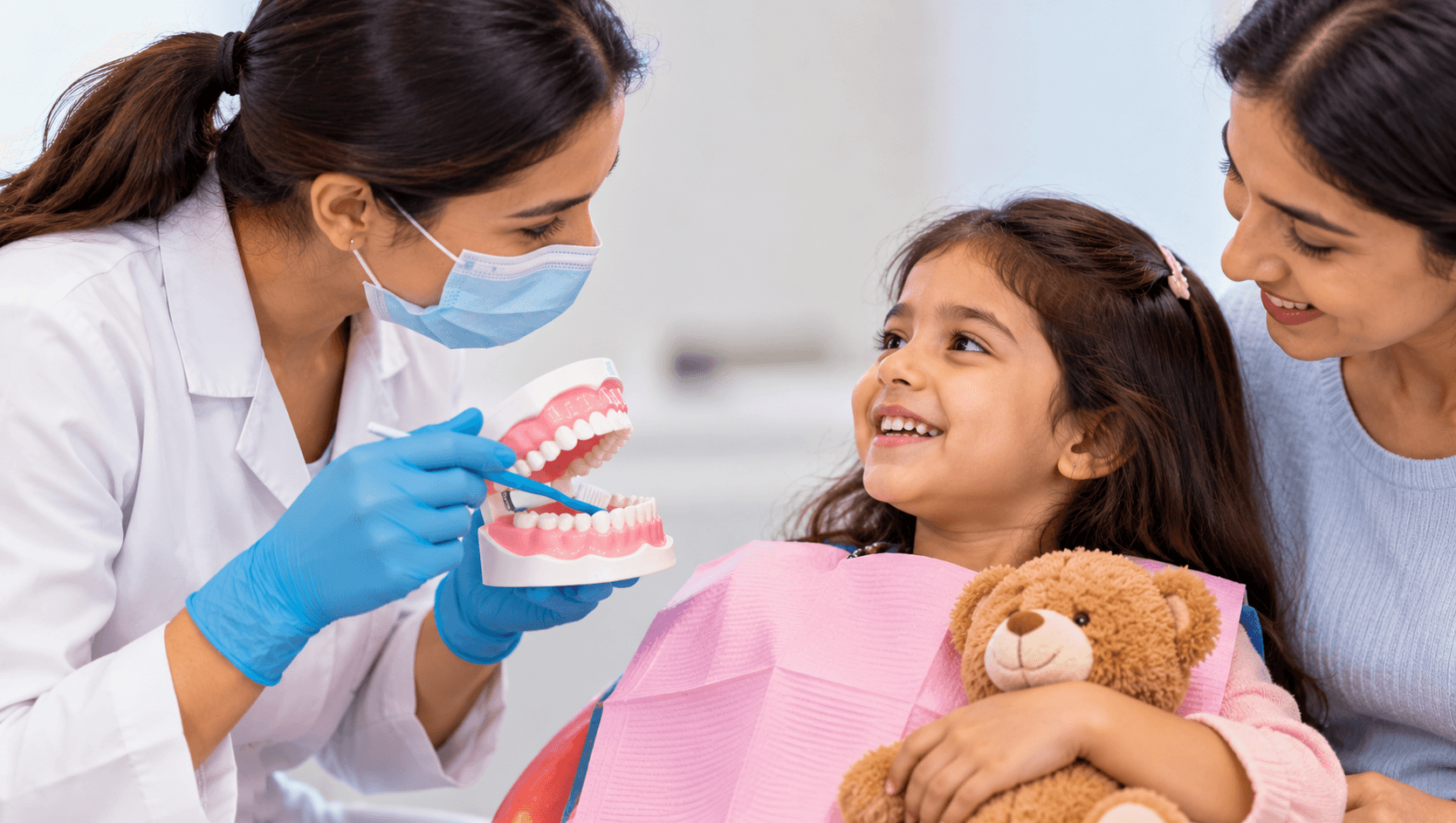
Tell-show-do. Explain in age-appropriate language, demonstrate on a model, a finger or the child's hand, then perform. This remains the single most effective technique in paediatric dentistry. Its power lies in removing surprise - most childhood dental fear is fear of the unknown rather than of pain.
Voice control. Deliberate modulation of tone and volume to direct attention and establish authority, immediately followed by a return to a warm tone once behaviour is regained. Used sparingly, it is effective; used frequently, it frightens.
Positive reinforcement. Specific praise for the behaviour you want - staying still, keeping the mouth open - rather than general praise. Reward immediately; young children do not connect delayed rewards with behaviour.
Distraction. Audiovisual distraction, conversation, counting, asking the child to raise a leg. Simple and underused.
Modelling. Letting an apprehensive child observe a cooperative sibling or peer.
Desensitisation. Breaking treatment into graded steps across appointments, starting with examination only, then polishing, then simple treatment. Slow, and extremely effective for the genuinely fearful child.
Enhancing control. Agreeing a stop signal - a raised hand - and honouring it absolutely. The honouring is the whole point. A clinician who ignores the stop signal once has lost the technique and the child's trust permanently.
Parental presence
Practice differs, and both positions are defensible, but the evidence favours flexibility over a fixed rule.
A calm parent can reassure a young child and is generally helpful with the under-fours, who are often not developmentally ready to separate.
An anxious or over-talkative parent interferes. Parents who repeatedly say it will not hurt introduce the idea of hurt, and parents who negotiate with the child undermine your authority.
The practical approach is to brief the parent before the appointment: explain what you will do, ask them to remain quiet and let you lead, and agree that you may ask them to step out if it would help. Framing it in advance is far better than asking a parent to leave mid-appointment, which the child reads as escalation.
Techniques that require caution and explicit consent
Protective stabilisation, formerly described as restraint, whether by a parent, an assistant or a device, is restricted in many jurisdictions, requires informed written consent, and should be used only where there is a clear clinical need and no reasonable alternative.
Techniques such as hand-over-mouth, once taught, are now widely considered unacceptable and are prohibited in many settings.
Whatever your local regulations permit, the standard to apply is this: would you be comfortable with this being filmed and shown to the parent afterwards? If not, do not do it. The child's long-term relationship with dentistry is worth more than one restoration.
Pharmacological management
When behavioural techniques are insufficient, or when the treatment need is beyond what a child can tolerate, pharmacological options come into consideration.
Nitrous oxide and oxygen inhalation sedation is the first step for most anxious but cooperative children. It is titratable, has rapid onset and recovery, and allows the child to remain conscious and communicative. It requires a child able to breathe through the nose and to cooperate with the hood - which means it supplements behaviour management rather than replacing it.
Oral and intravenous sedation have a role in specific circumstances, with appropriate training, monitoring and facilities.
General anaesthesia is appropriate for very young children with extensive treatment needs, children with significant special needs, acute infection requiring immediate comprehensive care, and children in whom all other approaches have genuinely failed. It carries its own risks and should be a considered decision, not a default when an appointment goes badly.
A principle worth holding onto: pharmacological management handles this episode of treatment. It does not teach the child to cope with dentistry. Where a child will need lifelong dental care, behavioural work should continue alongside and after any sedation or anaesthetic.
Prevention is the real behaviour management
The child who never needs an operative appointment never learns to fear one.
Early establishment of a dental home, with a first visit around the eruption of the first tooth or the first birthday, means the child's first experiences are examination, counting teeth and fluoride varnish, not drilling.
Caries risk assessment, dietary counselling with the parent, fluoride varnish, fissure sealants and supervised brushing do more for a child's lifelong relationship with dentistry than any behavioural technique applied in an emergency.
Treat the parent as the patient when the child is very young. The behaviours that produce early childhood caries - bottle at night, frequent sugary snacking, inadequate supervised brushing - are parental behaviours.
Our Pedodontics Course covers paediatric dentistry hands-on including behaviour management, pulp therapy and preformed crowns, and the Online Pedodontics Course covers the same syllabus remotely. Our Pediatric Dentistry Test Series covers the subject for licensing and postgraduate examinations.
Related reading: our articles on local anaesthesia techniques in dentistry and managing dental emergencies.