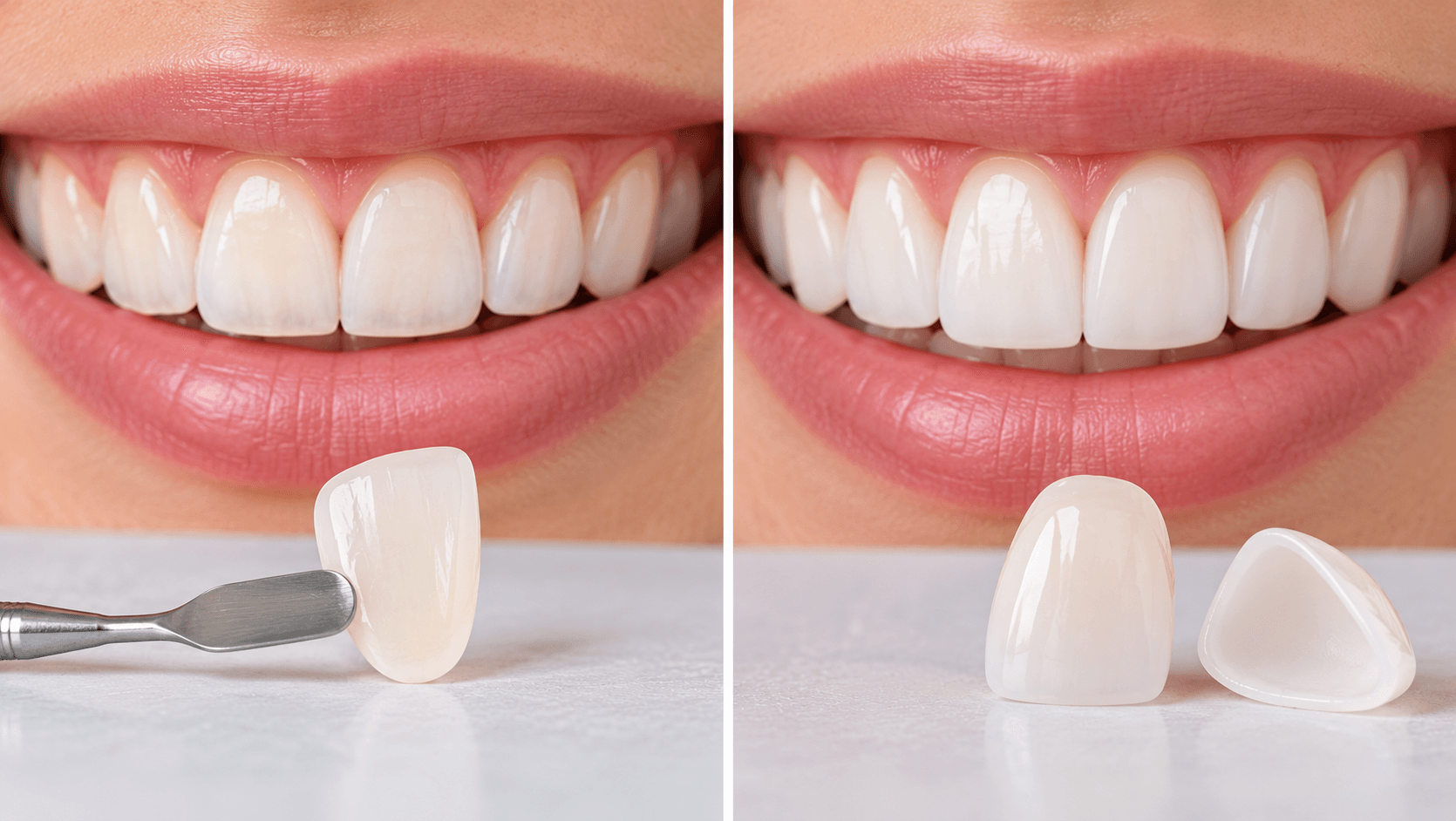
Two patients present on the same morning. Both want their upper anteriors improved. One is twenty-four, has mild enamel discolouration, intact teeth and limited budget. The other is forty-eight, has tetracycline staining, existing composite restorations on three teeth and significant wear.
The honest answer for one is direct composite. For the other it is ceramic. Getting this decision right matters more than being skilled at either technique, because the most common cause of an unhappy veneer patient is not poor execution - it is the wrong material chosen for their situation.
This article sets out how to make that choice.
What each material actually is
Direct composite veneers are built freehand or with a silicone index from a resin composite, in the mouth, in one appointment. Nothing is sent to a laboratory. The result is bonded to enamel, and in many cases requires little or no tooth preparation.
Indirect ceramic veneers are fabricated outside the mouth - feldspathic porcelain layered on a refractory die, or pressed and milled lithium disilicate - and bonded. They require at least two appointments, a laboratory, and in most cases some preparation.
There is also indirect composite, fabricated in a laboratory, which sits between the two and is less commonly used.
The real comparison is not composite versus ceramic as materials in the abstract. It is a single-visit, repairable, operator-dependent restoration against a multi-visit, more stable, technician-dependent one.
Longevity and failure modes
Ceramic veneers, well selected and well bonded to enamel, have substantially better long-term survival. The ceramic does not discolour, does not wear appreciably against enamel, and holds its surface polish for the life of the restoration.
Composite veneers discolour at the margins and across the surface over time, lose surface lustre, and are more prone to chipping and wear. They need polishing and periodic repair, and most will require replacement considerably sooner than a ceramic equivalent.
But the failure modes differ in a way that affects the decision. A chipped composite is repaired chairside in twenty minutes. A fractured ceramic veneer usually means remaking it, which means another laboratory fee and, frequently, further tooth preparation. The cheaper restoration fails more often but fails cheaply; the expensive one fails rarely but fails expensively.
That trade-off is a legitimate factor in patient counselling and should be stated plainly rather than glossed over.
Preparation and the enamel question
The single most important technical factor in veneer survival is whether the bond is to enamel or to dentine.
Bonding to enamel is predictable and durable. Bonding to dentine is less so, and a veneer with substantial dentine exposure at its margins has a materially worse prognosis. Preparation design should therefore be driven by the goal of staying in enamel wherever possible.
Composite veneers frequently require no preparation at all, or minimal enamel contouring, which keeps you entirely within enamel. This is a real clinical advantage, especially in young patients.
Ceramic veneers normally require preparation of roughly 0.3 to 0.7 mm depending on the region and the degree of colour change needed, which usually keeps you in enamel in a sound tooth but will not in a heavily restored or worn one.
This is also where the mock-up earns its place: preparing through a mock-up means you reduce relative to the final contour rather than the existing tooth, which is how you avoid removing more than necessary. Our Aesthetic and Cosmetic Dentistry Course covers this preparation discipline directly.
Masking discolouration
This is where ceramic has a clear advantage that composite cannot overcome with skill alone.
Masking a dark substrate requires either opacity or thickness. Composite's optical behaviour makes heavy masking difficult without the restoration becoming flat, grey or bulky. Severe tetracycline staining, a single dark non-vital tooth, or a discoloured core are therefore poor indications for direct composite.
Ceramic, particularly lithium disilicate in higher-opacity ingots, can mask a dark substrate within an acceptable thickness while retaining depth and translucency. The trade is that greater opacity needed for masking reduces the natural translucency that makes a veneer look alive, so there is a limit even in ceramic - and beyond it, a crown with an opaque core is the honest answer.
For mild discolouration, where the goal is brightening rather than masking, both materials work and composite is often the better value.
Case selection: when composite is the right answer
Young patients with intact enamel, where tooth preservation is the overriding concern and where the restoration will almost certainly need replacing at some point in a long life anyway.
Minor shape corrections: peg laterals, diastema closure, worn incisal edges, small enamel defects.
Budget-constrained patients, where the alternative is no treatment at all.
As a diagnostic or transitional restoration, allowing the patient to live with a proposed shape and length before committing to ceramic.
Patients with active parafunction where you expect chipping, since repairability becomes the dominant consideration.
Single-tooth additions where blending with adjacent natural teeth is easier to achieve incrementally in the mouth than to communicate to a laboratory.
Case selection: when ceramic is the right answer
Significant discolouration requiring masking.
Multiple adjacent teeth where consistent shade, surface texture and contour across the segment are required - achieving uniformity across six to eight direct composite veneers freehand is extremely demanding.
Patients who want maximum longevity and stability of appearance, and who understand and accept the cost.
Cases where the existing restorations are extensive enough that a direct approach would be building composite onto composite.
Cases involving changes to incisal edge position, length or occlusal scheme, where a planned laboratory wax-up and a stable material are preferable.
Heavy staining habits - smoking, strong tea or coffee, red wine - where composite will discolour quickly.
The factors that override material choice
Three things should be settled before the composite-versus-ceramic conversation happens at all.
Is the patient's existing dentition healthy? Active caries, untreated periodontal disease and unmanaged parafunction must be addressed first. A veneer bonded to a periodontally compromised tooth or placed in a bruxist without a splint is a restoration with a deadline.
Is the patient's expectation achievable? The mock-up and trial smile answer this better than any conversation, and should be routine for every anterior case in both materials.
Is a veneer the right restoration at all? Orthodontics corrects position without removing tooth structure, and bleaching corrects colour without removing any at all. A proportion of patients who present asking for veneers are better served by aligners and whitening, and telling them so builds more trust than treating them.
Our Online Aesthetic Dentistry Course covers cosmetic treatment planning and smile makeover protocols, and our classroom Aesthetic and Cosmetic Dentistry Course covers veneer preparation and layering hands-on. For the direct composite technique specifically, see our Restorative Dentistry courses.
Related reading: our guide to smile makeover techniques and our digital smile design workflow article.