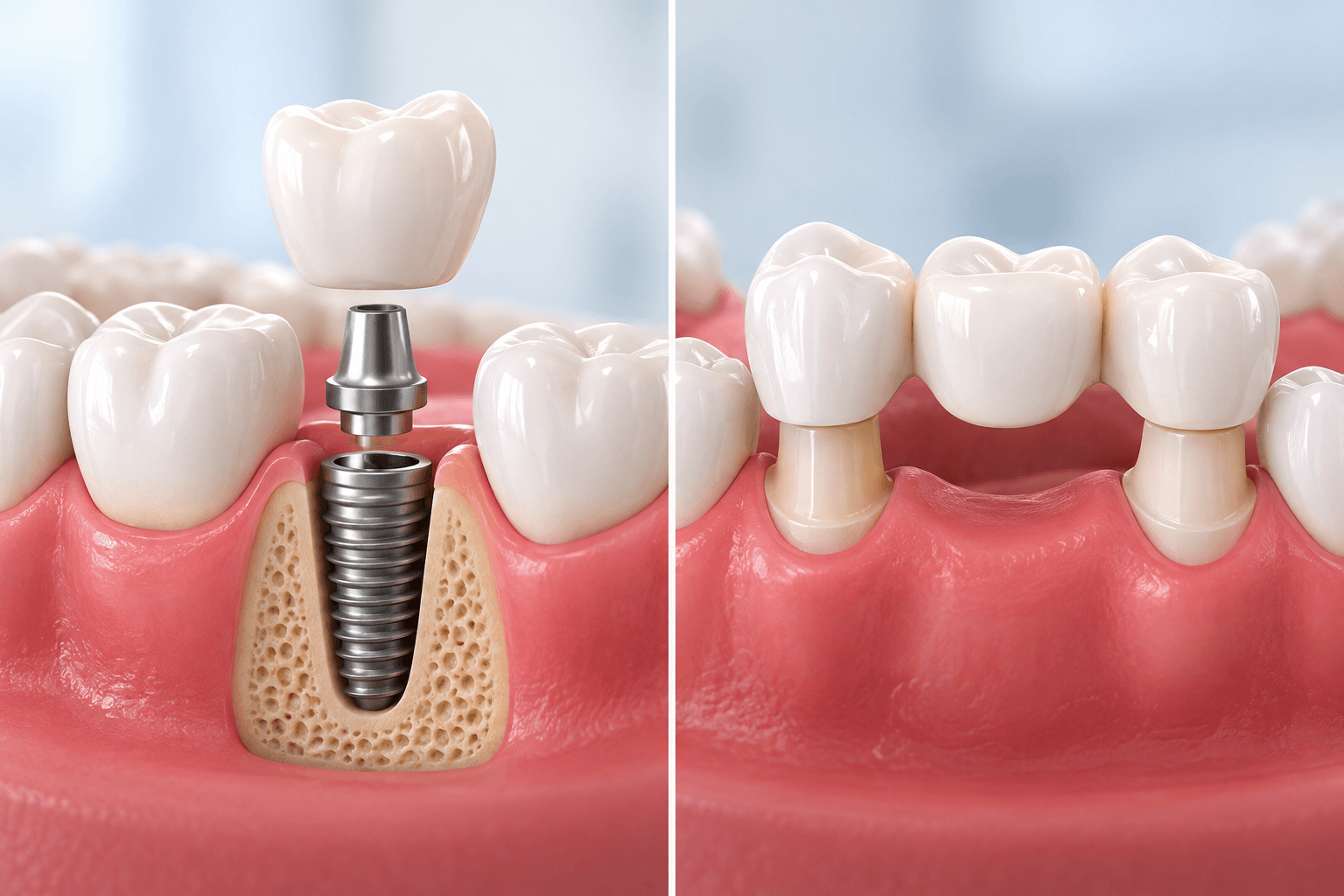
Dental Implant vs Dental Bridge
Losing a tooth can affect your smile, chewing, and confidence. Today, there are several ways to replace a missing tooth. Two common options are dental implants and dental bridges.
Both treatments can restore a missing tooth, but they work differently. Your dentist can recommend the most suitable option after checking your teeth, gums, and jawbone.
What Is a Dental Implant?
A dental implant is a small post placed into the jawbone to replace the root of a missing tooth. After healing, a dental crown is placed on the implant.
Dental implants can look and feel similar to natural teeth and provide stable support for the replacement tooth.
Benefits of Dental Implants
Natural-looking tooth replacement
Strong and stable support
Does not usually require cutting down healthy neighboring teeth
Helps provide stimulation to the jawbone
Can replace one or several missing teeth
Easy to care for with good oral hygiene
What Is a Dental Bridge?
A dental bridge is a fixed replacement for a missing tooth. It uses the teeth next to the empty space to support the artificial tooth.
A bridge can often be completed in less time than an implant because it does not require implant placement and healing.
Benefits of Dental Bridges
Replaces missing teeth
Restores chewing function
Improves the appearance of your smile
Fixed in the mouth
Does not require implant surgery
May be completed faster in suitable cases
Which One Should You Choose?
There is no single treatment that is right for everyone.
Your dentist may consider:-
The condition of your neighboring teeth, Jawbone health, Gum health, Number of missing teeth, Your overall oral health, Treatment time, Your budget and preferences
A dental examination and dental X-ray or other imaging may be recommended before deciding on treatment.
How Long Do They Last?
Both dental implants and dental bridges can provide long-term tooth replacement when they are properly planned and maintained.
Regular dental check-ups and good oral hygiene are important for keeping your restoration healthy.
How to Care for Your New Tooth
Whether you choose an implant or bridge, proper care is important.
Brush twice daily, Clean between your teeth, Follow your dentist's cleaning instructions, Visit your dentist regularly, Avoid biting very hard objects, Contact your dentist if you notice pain, swelling, bleeding, or movement
Frequently Asked Questions
Are dental implants better than bridges? Both have different benefits. The suitable option depends on your teeth, gums, jawbone, and individual treatment needs.
Is a dental bridge cheaper than an implant? In many cases, a bridge may have a lower initial cost, but the total cost depends on the treatment required for each patient.
Do dental implants look natural? Yes. A properly planned dental implant and crown can be made to closely match your natural teeth.
Can one missing tooth be replaced with an implant? Yes. A single dental implant can be used to replace one missing tooth when the patient is suitable for implant treatment.
How do I know which option is right for me? A dentist can examine your mouth, neighboring teeth, gums, and jawbone and explain the available treatment options.
Conclusion
Both dental implants and dental bridges are useful options for replacing missing teeth. An implant replaces the tooth root, while a bridge uses neighboring teeth for support.
If you have a missing tooth, consult a dentist to understand which tooth replacement treatment is suitable for your oral health and needs.