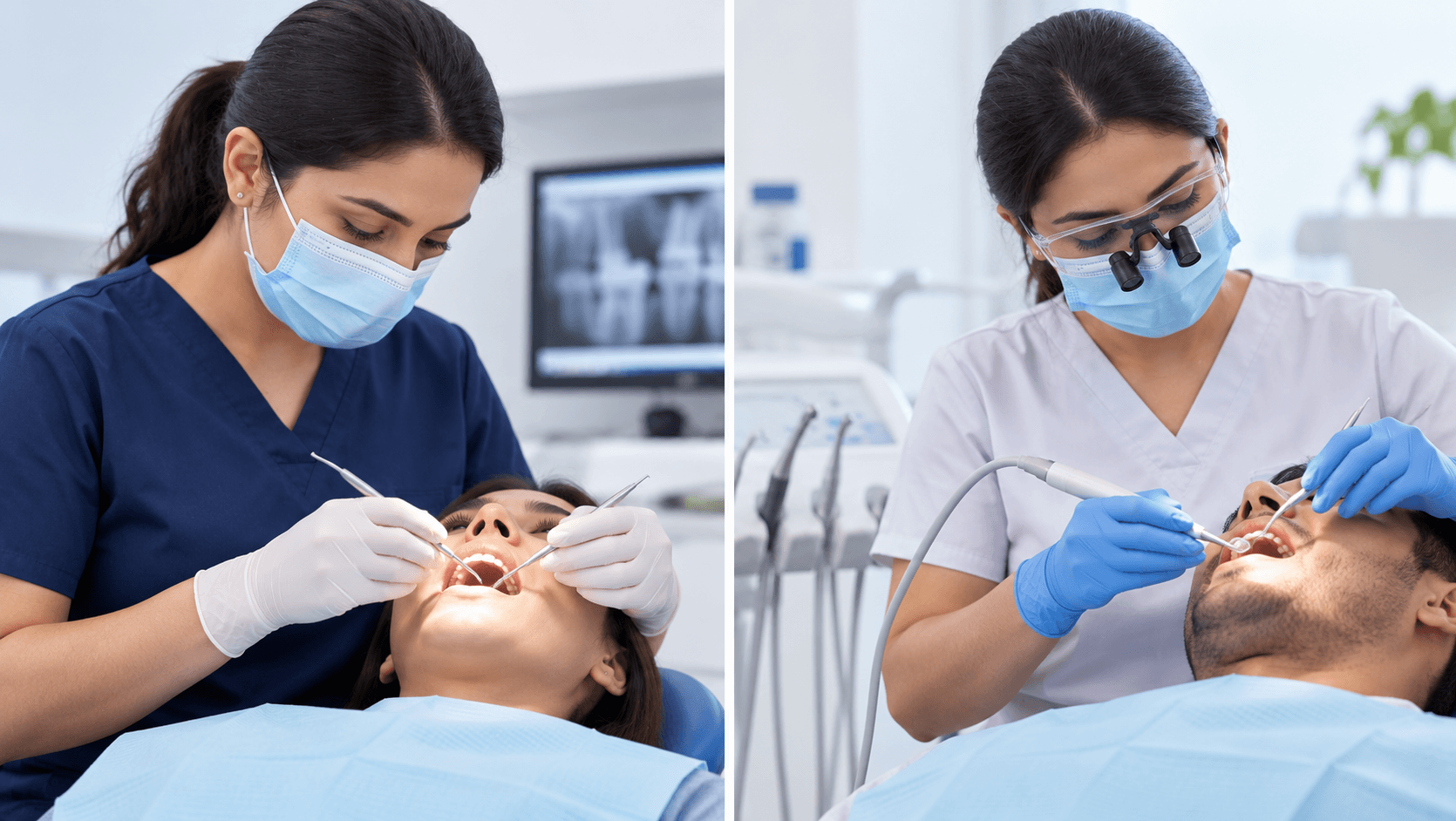
These two roles are routinely confused, including by people already working in dentistry. They share a great deal - both are registered oral health professionals, both work extensively in prevention and periodontal care, and in several countries they are taught together on the same programme.
But the scopes are not the same, and the difference is clinically and commercially significant. A therapist can restore teeth. A hygienist, in most jurisdictions, cannot.
This guide sets out what each role can do, how the training differs, how they are paid and employed, and how to move between them.
The core distinction
A dental hygienist works primarily in prevention and the non-surgical management of periodontal disease: periodontal assessment and charting, scaling and root surface debridement, ultrasonic and hand instrumentation, polishing, fluoride, sealants and oral hygiene education.
A dental therapist does all of that and adds a restorative and minor surgical component: direct restorations in permanent and primary teeth, extraction of primary teeth, pulpotomy on primary teeth, placement of preformed crowns, and in some systems treatment of children under defined supervision arrangements.
That additional scope is the whole of the practical difference. It changes what a practice can delegate, what a therapist is worth to an employer, and what kind of clinical day each role has.
It is worth saying clearly that neither scope includes diagnosis and treatment planning in the sense a dentist performs them, nor extraction of permanent teeth, nor prescribing in most jurisdictions.
Oral health therapy: the combined qualification
In Australia and New Zealand the standard qualification is a bachelor's degree in oral health, which registers the graduate as an oral health therapist - dual-qualified in both dental hygiene and dental therapy.
In the United Kingdom, many programmes are combined dental hygiene and dental therapy, producing a dual-qualified practitioner registered with the General Dental Council in both titles.
This matters when you are choosing a programme. In systems where the dual qualification is standard, a hygiene-only credential is a narrower product in the same job market, and employers who could hire a dual-qualified practitioner for similar money usually will.
It also matters if you qualified in hygiene alone and are now limited by it: conversion or top-up programmes in dental therapy exist in several systems precisely for this reason, and are typically much shorter than starting again.
Training and entry
Both roles require a programme accredited by the relevant national regulator. An unaccredited programme will not lead to registration, and that is the single most important thing to verify before enrolling anywhere.
Hygiene-only programmes are generally shorter. Therapy and combined oral health programmes are longer, because the restorative component requires substantial additional preclinical and clinical hours.
Entry requirements usually include science subjects at secondary level and, for degree programmes, a competitive academic record. Some systems favour applicants with prior dental assisting experience.
In India, dental hygienist and dental therapist courses are offered as diploma and certificate programmes, with scope narrower than in the UK, Australia or New Zealand. Our Dental Therapist Course in India covers classroom therapy training, and our Online Dental Therapist Course delivers the syllabus remotely; the equivalent hygiene courses are listed alongside them.
If your intention is to practise abroad, confirm with the destination regulator how your intended qualification will be assessed before you enrol. Credential assessment is the step that determines whether a qualification is useful internationally, and it is far cheaper to check first.
Employment and earnings
Therapists and dual-qualified practitioners generally command higher earnings than hygienists, because the restorative scope allows a practice to delegate work that would otherwise occupy a dentist's chair time. That is the economic logic employers apply, and it holds across systems.
Hygienists have broader availability of part-time and multi-practice work, which suits people who want flexibility.
Both roles have strong employment demand in the UK, Australia, New Zealand, Canada and the United States. In India, both roles are less established and lower paid, though demand is rising as multi-chair and corporate practices adopt delegated-care models.
Direct access provisions - where patients may see a hygienist or therapist without first seeing a dentist - exist in several systems within defined limits and have expanded the independent scope of both roles considerably.
How to choose
Choose hygiene if you want a focused preventive and periodontal career, value a shorter route to registration, and want maximum flexibility in working patterns.
Choose therapy, or a combined oral health programme, if you want restorative clinical work, higher earning potential, and the widest employment options - particularly in systems where the dual qualification is the norm.
Choose based on the system you intend to work in, not on general advice. A hygiene-only qualification is a strong credential in the United States and a comparatively narrow one in Australia.
And if you are already qualified in hygiene and want the restorative scope, look at conversion and top-up routes before assuming you would have to start over.
Related reading on this site: our guide to becoming a dental hygienist, our guide to becoming a dental assistant, and our international licensing exam test series for dental hygienists, therapists and assistants.