Lasers occupy an awkward position in general dentistry. The marketing promises painless, drill-free treatment; the sceptics dismiss them as expensive gingival retraction devices. Both positions are wrong, and the reason is that there is no such thing as a dental laser in the singular.
There are several wavelengths with substantially different tissue interactions, and a laser that is excellent for one application may be useless for another. Buying the wrong wavelength for your intended use is the most common and most expensive mistake dentists make with this technology.
This guide explains what each wavelength does, what the genuine indications are, and what to buy first.
Why wavelength determines everything
Laser energy does work only when it is absorbed. What absorbs it depends on the wavelength, and the primary absorbers in oral tissue are water, hydroxyapatite, haemoglobin and melanin.
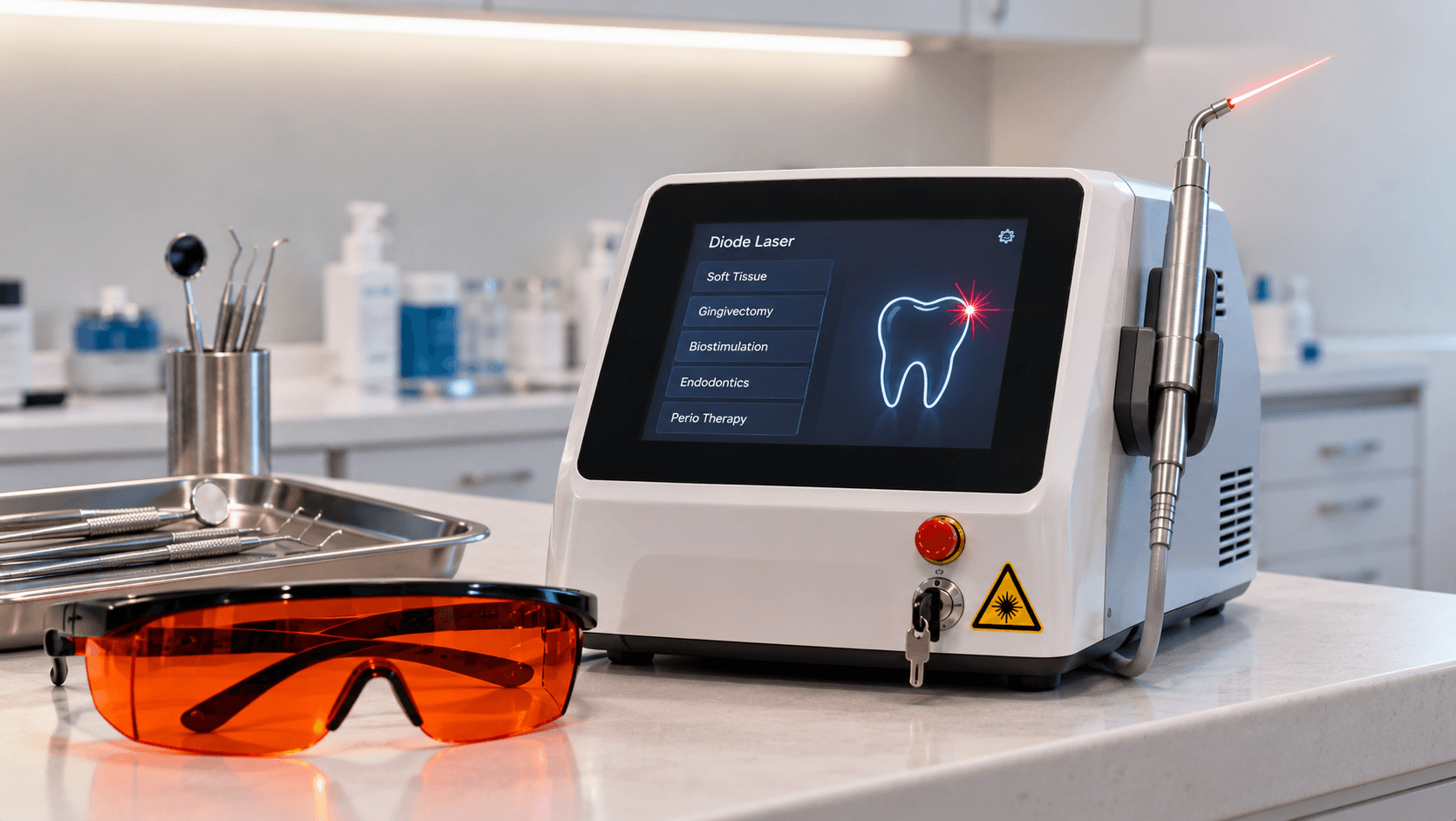
Diode wavelengths, broadly in the 810 to 980 nm range, are absorbed strongly by haemoglobin and melanin and poorly by water and hydroxyapatite. That makes them effective on pigmented and vascular soft tissue, and essentially inert on enamel and dentine.
Nd:YAG at 1064 nm behaves similarly, with deeper tissue penetration.
Erbium wavelengths - Er:YAG at 2940 nm and Er,Cr:YSGG at 2780 nm - are absorbed very strongly by water and well by hydroxyapatite. That is what allows them to cut hard tissue, and it is why they are the only wavelengths that can genuinely replace a bur for caries removal.
CO2 at 10,600 nm is absorbed strongly by water, making it an efficient soft tissue cutter with good haemostasis.
Everything else follows from this. A diode cannot cut enamel, no matter what the brochure implies. An erbium can, but is a less efficient soft-tissue coagulator than a diode. This is why practices that use lasers seriously often own two.
Soft tissue applications
This is where most general dentists start, and where diode lasers earn their place.
Gingivectomy and gingivoplasty, including crown lengthening in suitable cases where no osseous recontouring is required.
Soft tissue troughing for impressions and scanning, as an alternative to retraction cord. This is the single most-used application in restorative practice, because it is quick, bloodless and gives a clean, readable margin.
Frenectomy, labial and lingual. Fast, with minimal bleeding and often without sutures.
Operculectomy for pericoronitis.
Biopsy of soft tissue lesions - with the caveat that thermal artefact at the margin can compromise histopathological assessment, so excisional margins must be planned generously and the pathologist told a laser was used.
Treatment of aphthous ulcers and herpetic lesions for symptomatic relief. Haemostasis and coagulation. Gingival depigmentation, where melanin absorption makes diode lasers particularly effective.
The clinical advantages that matter day to day are haemostasis, reduced need for sutures, and often reduced postoperative discomfort. The disadvantage is a slower cut than a scalpel and a learning curve in controlling thermal damage.
Hard tissue applications
Erbium wavelengths only.
Caries removal and cavity preparation, in selected cases, with the genuine benefit that many preparations can be completed without local anaesthesia - which is of real value in paediatric and anxious patients.
Enamel and dentine conditioning prior to bonding. Osseous surgery and crown lengthening involving bone. Apicoectomy and root-end preparation.
The honest assessment is that erbium caries removal is slower than a high-speed handpiece for routine cavity preparation in a cooperative adult. Its value is concentrated in paediatric dentistry, anxious patients, and situations where avoiding anaesthesia and vibration changes the whole appointment. Dentists who buy an erbium expecting to abandon the drill entirely are usually disappointed; those who buy it for paediatric and anxious patients are usually pleased.
Periodontal and endodontic applications
In periodontics, lasers are used for sulcular debridement and bacterial reduction as an adjunct to scaling and root planing, and for soft tissue management in flap procedures. The important word is adjunct: the evidence supports lasers as additional to mechanical debridement, not as a replacement for it. A clinician who scales less because they have a laser will get worse results.
In endodontics, laser-activated irrigation uses laser energy to agitate irrigant within the canal system, improving penetration into areas instrumentation cannot reach. This is a legitimate and growing application, and it sits alongside ultrasonic activation rather than replacing the need for adequate irrigant volume and contact time.
Photobiomodulation, or low-level laser therapy, is used for pain reduction, management of oral mucositis, temporomandibular disorder symptoms and wound healing support. The evidence base varies considerably by indication, and claims should be assessed indication by indication rather than accepted wholesale.
Safety, which is not optional
Dental lasers are classified under international standards, and the surgical wavelengths used in dentistry are Class 4 - capable of causing eye and skin injury, and of igniting flammable material.
The requirements that follow are specific. Wavelength-specific protective eyewear for operator, assistant and patient; eyewear rated for a diode does not protect against an erbium. A designated laser-controlled area with signage and restricted access while the laser is in use. A nominated laser safety officer with defined responsibilities. Documented local rules and a protocol for use.
High-volume evacuation for the laser plume, which contains viable material and particulates.
Avoidance of alcohol-based and other flammable preparations in the operating field, and care with oxygen.
Attention to thermal effects: inadequate water cooling with erbium wavelengths causes thermal damage to pulp and bone, and excessive power settings in soft tissue produce charring and delayed healing. Most laser complications in practice are thermal, and nearly all are a consequence of using too much power because the operator was in a hurry.
Jurisdictional requirements for registration, training and certification differ and must be checked locally before use.
What to buy, and in what order
For most general dentists, a diode is the right first purchase. It is the least expensive, the easiest to learn, and it addresses the soft tissue applications that arise weekly in restorative and periodontal practice - troughing, gingival contouring, frenectomy, operculectomy.
An erbium is the right second purchase, and only if your case mix justifies it: substantial paediatric work, a significant anxious-patient population, or a periodontal and surgical caseload that uses osseous applications.
Before either, get trained properly. Laser dentistry is one of the few areas where the technology genuinely can harm the patient in inexperienced hands, through thermal injury that is not immediately visible. Settings, power density, contact versus non-contact technique, tip selection and water cooling are not details - they are the procedure.
Our Laser Dentistry Course for Dentists covers hands-on dental laser training including wavelength selection, soft tissue procedures and safety protocols, and our Online Laser Dentistry Course covers the same theory and case planning remotely.
Related reading on this site: our articles on the 2017 periodontal classification, why root canals fail, and digital smile design workflows.