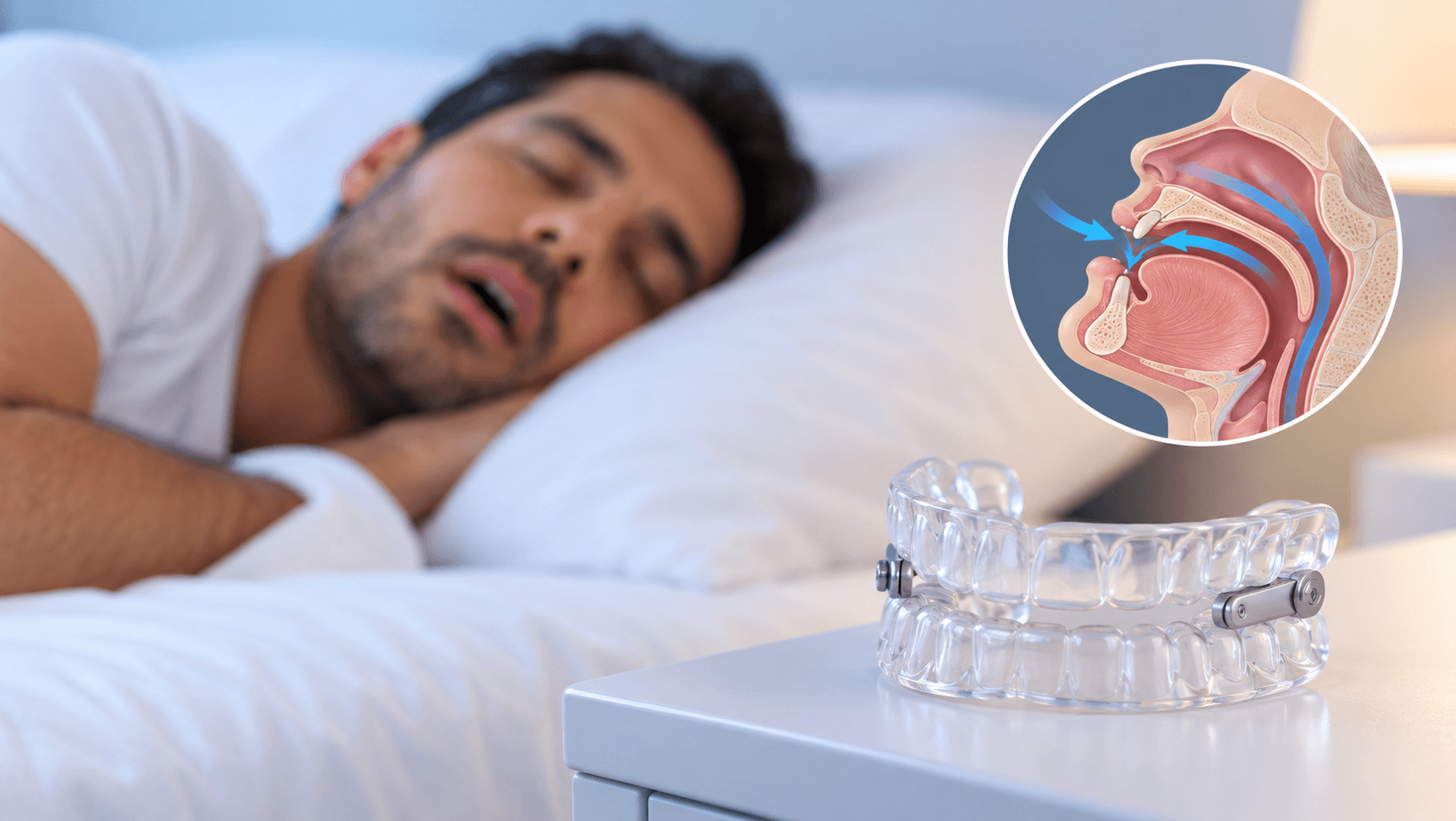
Dentists see patients more regularly than most physicians do, examine the upper airway at every appointment, and routinely encounter the signs that accompany obstructive sleep apnoea - bruxism, scalloped tongue borders, a crowded oropharynx, enlarged tonsils, a high narrow palate, retrognathia.
They are, in other words, unusually well placed to notice a serious and widely undiagnosed condition. Obstructive sleep apnoea is associated with hypertension, cardiovascular disease, stroke, type 2 diabetes, impaired cognition and a markedly increased risk of road traffic accidents, and a large proportion of people who have it do not know.
This guide covers the dentist's legitimate role: screening and referral, the delivery of oral appliance therapy when it is prescribed, and the long-term dental consequences you must monitor. It is equally clear about where that role ends.
What OSA is
During sleep, muscle tone in the upper airway falls. In susceptible individuals the pharyngeal airway collapses partially or completely, producing hypopnoea or apnoea, repeated oxygen desaturation, and arousals that fragment sleep.
Severity is graded by the apnoea-hypopnoea index - events per hour of sleep - derived from a sleep study, and divided into mild, moderate and severe categories that guide treatment choice.
Risk factors include obesity and increased neck circumference, male sex, increasing age, menopause, retrognathia and a small mandible, tonsillar and adenoid hypertrophy particularly in children, nasal obstruction, alcohol and sedatives, and smoking.
Snoring is the symptom patients report. It is not the condition, and primary snoring without apnoea is a different clinical entity with different implications.
Screening in the dental chair
Two validated instruments are short enough to use routinely.
STOP-BANG asks about Snoring, Tiredness, Observed apnoeas, blood Pressure, BMI, Age, Neck circumference and Gender. It is a screening tool with high sensitivity, which is exactly what you want in a dental setting - the objective is not to miss people, not to make a diagnosis.
The Epworth Sleepiness Scale quantifies daytime sleepiness across eight everyday situations.
Alongside these, the dental examination contributes findings a physician will not have: Mallampati or Friedman tongue position, tonsillar size, palatal vault form, maxillary and mandibular relationship, evidence of bruxism and attrition, tongue scalloping, and any history of morning headache, dry mouth or nocturia.
Asking about the bed partner's observations is often the single most informative question available to you.
Where the dentist's role stops
This needs to be stated without hedging: dentists do not diagnose obstructive sleep apnoea.
Diagnosis requires a sleep study - polysomnography or an accepted home sleep apnoea test - interpreted by a physician qualified to do so. A dentist who fits an appliance for presumed sleep apnoea without a diagnosis is treating an undiagnosed medical condition, may be masking severe disease, and is practising outside any defensible scope.
The correct sequence is: screen, document your findings, refer to a physician or sleep clinic, and act on the diagnosis and prescription that come back.
That sequence protects the patient, and it protects you.
Oral appliance therapy
The mandibular advancement device holds the mandible forward during sleep, advancing the tongue base and soft palate and increasing pharyngeal airway dimension.
It is generally indicated for primary snoring, for mild to moderate OSA, and for patients with severe OSA who cannot tolerate or will not use CPAP.
Continuous positive airway pressure remains more effective at reducing the apnoea-hypopnoea index, particularly in severe disease. Oral appliances are usually better tolerated, and real-world adherence is higher. Because the benefit a patient actually receives is efficacy multiplied by adherence, the two can be closer in practice than the raw efficacy figures suggest - a point worth making to patients who have abandoned CPAP and assume they have no option left.
Tongue-retaining devices, which hold the tongue forward directly, are an alternative for edentulous patients or those with insufficient dentition to retain a mandibular advancement device.
Fitting an appliance properly
Custom devices outperform boil-and-bite and over-the-counter products, which should not be used for diagnosed OSA.
Assess suitability first: sufficient healthy teeth for retention, periodontal health adequate to bear the forces, an acceptable range of mandibular protrusion, and a temporomandibular joint that will tolerate sustained protrusion. Record the protrusive range with a gauge.
Take accurate records, including a construction bite at a defined percentage of maximum protrusion rather than at maximum protrusion itself.
Use an adjustable, titratable device. Start conservatively and advance gradually over weeks, guided by symptoms and bed-partner report, until benefit is achieved or side effects limit further advancement.
Most importantly, arrange objective reassessment. A repeat sleep study with the appliance in place, organised with the referring physician, is how you establish that the treatment is actually working. Symptomatic improvement alone is not sufficient evidence in a condition whose cardiovascular risk is driven by events the patient sleeps through.
Side effects you will have to manage
These are the reason the dentist stays involved long term, and they are genuinely common.
Temporomandibular joint and muscle discomfort, especially early. Usually transient; occasionally it limits advancement.
Tooth tenderness and mobility. Excessive salivation or dry mouth.
Occlusal change, which is the one that matters most. Sustained protrusion over years can reduce overjet and overbite, retrocline upper incisors and procline lower incisors, and alter posterior contacts. Patients must be informed of this before treatment starts, not after they notice it.
Mitigation includes morning repositioning exercises and a repositioning appliance, conservative titration, and systematic monitoring: baseline records including photographs and models or scans, with periodic comparison.
Review is not optional in this therapy. Build it into the treatment plan, and charge for it.
Building this into a practice
Start by screening. Adding STOP-BANG and Epworth to your medical history costs nothing and will identify patients already on your list.
Build a referral relationship with a sleep physician or respiratory clinic before you need one. Dental sleep medicine works when dentist and physician communicate; it fails when the dentist operates alone.
Learn the appliance protocols properly before offering them. Protrusive measurement, construction bite technique, titration and the management of side effects are specific skills, not extensions of splint therapy.
Screen children too. Paediatric OSA presents differently - with behavioural problems, inattention, mouth breathing and enuresis rather than daytime sleepiness - and adenotonsillar hypertrophy is a common cause. Referral for ENT assessment, and consideration of orthodontic approaches such as maxillary expansion, belong in the paediatric pathway.
Our Classroom Obstructive Sleep Apnea and Dental Sleep Medicine Course covers screening, appliance selection, titration and side-effect management hands-on, and the Online Obstructive Sleep Apnea Course covers the same material remotely. Our TMJ course covers the joint assessment that should precede appliance therapy.
Related reading: our articles on dental occlusion in diagnosis and treatment planning, temporomandibular disorders, and medical emergencies in dental practice.